
Most Texas small businesses are leaving free customers on the table. Not because SEO is too expensive or too technical, but because they don't know which actions actually move the needle locally. The good news? A handful of proven, affordable strategies can put your business in front of local searchers fast. This guide walks you through exactly what to prioritize, from claiming your Google Business Profile to building local credibility, so you can stop guessing and start ranking.
Table of Contents
- Choose the right SEO foundation: What matters most in Texas
- 1. Claim and optimize your Google Business Profile
- 2. Optimize your website for local SEO
- 3. Build local links and citations without blowing your budget
- 4. Manage reviews and monitor reputation for long-term gains
- 5. Set realistic SEO expectations: Budget, results, and DIY vs. hiring help
- Affordable website and SEO help for Texas small businesses
- Frequently asked questions
Key Takeaways
| Point | Details |
|---|---|
| Optimize Google Business Profile | Claiming and managing your profile can dramatically improve local search visibility at no cost. |
| Focus on local website SEO | Use Texas-specific keywords and ensure a fast, mobile-friendly website for higher rankings. |
| Build real local links | Partner with trusted Texas organizations to boost authority and outperform competitors. |
| Prioritize reputation management | Encourage and respond to reviews to attract more customers and rise in rankings. |
| Plan realistic budgets | Most see results within months by investing $500-2000 per month, even using affordable tactics. |
Choose the right SEO foundation: What matters most in Texas
Not all SEO tactics are equal, especially in a state as competitive as Texas. Before you spend a dollar or an hour on optimization, you need to know which signals Google actually uses to rank local businesses. Understanding SEO basics helps you focus your energy where it counts.
The four pillars every Texas small business should build on are:
- Google Business Profile (GBP): Your single most powerful free tool for local search visibility
- Local on-page keywords: City and neighborhood terms woven into your website titles, headings, and content
- Backlinks and citations: Mentions and links from trusted local sources that prove your credibility
- Mobile optimization: A fast, mobile-friendly site that works on every screen size
Here's something most business owners don't realize. Google doesn't just rank the closest business. It weighs prominence, meaning your reviews, backlinks, and overall online authority, more heavily than physical distance in competitive markets. As Moz explains, GBP is the number one local ranking factor, and prominence beats proximity when competition is fierce.
"In competitive Texas markets, the business with the most reviews and strongest local links will outrank a closer competitor almost every time."
This means a plumber in Austin with 200 reviews and a well-optimized profile will beat a closer competitor with 10 reviews and a bare-bones listing. Start with Texas website optimization and build from there.
1. Claim and optimize your Google Business Profile
Your Google Business Profile is free, powerful, and criminally underused by most Texas small businesses. If you haven't claimed yours yet, that's your first move today.
Here's a step-by-step checklist to get it right:
- Claim your listing at business.google.com and verify ownership via phone or postcard
- Enter accurate NAP (name, address, phone number) that matches your website exactly
- Choose the right primary category (be specific: "Mexican Restaurant" beats "Restaurant")
- Add all secondary categories that apply to your services
- Upload real photos of your storefront, team, products, and work
- Write a keyword-rich business description that mentions your city and services
- List every service you offer with descriptions and prices where possible
- Set accurate hours and update them for holidays
- Enable messaging so customers can contact you directly from search
- Post weekly updates, specials, or events to stay active in Google's eyes
According to the Local SEO Small Business Guide 2026, a fully optimized GBP is the cornerstone of local SEO for Texas small businesses. Businesses that post regularly and respond to reviews consistently appear higher in the local pack.
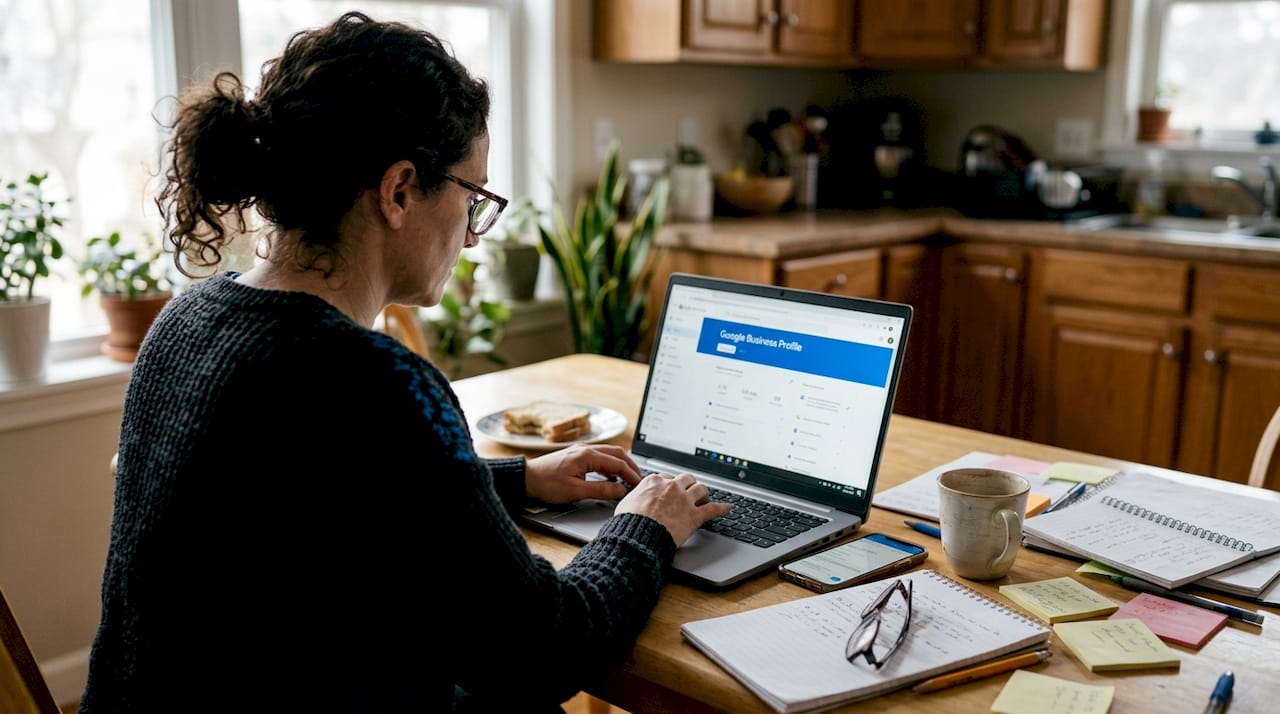
Pro Tip: Use real photos taken at your actual location, not stock images. Google can detect authenticity, and customers trust real photos far more. Post at least one update per week, even if it's just a quick special or a behind-the-scenes shot.
Reviews are a massive part of your GBP strength. The importance of online reviews cannot be overstated. Businesses with more reviews and higher ratings earn more clicks and rank higher, because local SEO authority is built on trust signals, and reviews are the clearest trust signal Google has. Want to improve your online presence fast? Start here.
2. Optimize your website for local SEO
Your Google profile gets people interested. Your website closes the deal. But it can only do that if Google can actually find and understand it.
Here's what to prioritize for local website SEO in Texas:
- Page titles and meta descriptions: Include your city name and main service (example: "Plumber in San Antonio, TX")
- Homepage content: Mention your location naturally in the first paragraph
- Contact page: List your full address, phone, and a Google Maps embed
- Mobile speed: Texas ranks in the top five states for mobile search usage, so a slow mobile site costs you real customers
- LocalBusiness schema: This is a small piece of code that tells Google exactly who you are, where you are, and what you do
The on-page SEO fundamentals are straightforward: optimize titles and meta descriptions with local keywords, prioritize mobile speed, and add schema markup for LocalBusiness to send extra ranking signals.
| On-page element | What to include | Why it matters |
|---|---|---|
| Page title | City + service keyword | Tells Google what you rank for |
| Meta description | Location + benefit + call to action | Improves click-through rate |
| Homepage H1 | Primary service + city name | Strongest on-page signal |
| Contact page | Full NAP + map embed | Confirms local relevance |
| Schema markup | Business type, address, hours | Boosts local pack eligibility |
Pro Tip: Your homepage and contact page are your two highest-value pages for local SEO. Optimize those two first before touching anything else. A well-built SEO friendly web design makes this process much easier from the start. Check out the full Texas website design guide for a deeper look at what works in this market.
3. Build local links and citations without blowing your budget
Links from other websites to yours are like votes of confidence. Local links, specifically from Texas-based sources, carry extra weight because they confirm your geographic relevance to Google.
Here are the top five citation sources every Texas SMB should be listed on:
- Your local Chamber of Commerce (Dallas, Houston, San Antonio, Austin, Lubbock, and others all have active directories)
- Better Business Bureau (BBB): A trusted, authoritative citation that also builds consumer trust
- Yelp: Still one of the most powerful local directories for service businesses
- Apple Maps and Bing Places: Often overlooked but important for full local coverage
- Local news sites and blogs: A mention in the Dallas Morning News or a local neighborhood blog carries real SEO weight
As Moz's local authority guide makes clear, earning backlinks and citations from Texas chambers, local directories, and regional news outlets is one of the most effective ways to build competitive local authority. Sponsoring a local event or partnering with a neighboring business can earn you a link that no amount of paid advertising can replicate.
"A single link from your city's Chamber of Commerce website is worth more than 50 links from generic, low-quality directories."
| Link source | Quality level | Cost |
|---|---|---|
| Local Chamber of Commerce | High | Free or low membership fee |
| BBB listing | High | Free basic listing |
| Spammy link farms | Harmful | Often paid, never worth it |
| Local news mention | Very high | Free (earned through PR) |
| Generic directories | Low | Free but minimal impact |
Focus your energy on quality over quantity. Five strong local links beat 500 spammy ones every time. If you're just getting started, the guide to building a local business website covers how to set up a site that earns links naturally.
4. Manage reviews and monitor reputation for long-term gains
Reviews are not just a nice-to-have. They are a direct ranking factor in local search. Google measures review volume, average rating, and how recently reviews were posted. All three matter.
Here are the easiest ways to generate more reviews consistently:
- Send a follow-up email or text after every completed job or sale with a direct link to your Google review page
- Add a QR code to your receipts, business cards, or storefront window that links straight to your review form
- Train your team to ask satisfied customers in person before they leave
- Respond to every review, positive and negative, within 48 hours
Responding to negative reviews publicly is one of the most underrated SEO moves a small business can make. It shows Google and future customers that you take feedback seriously. Keep responses professional, brief, and solution-focused.
Pro Tip: Set up a free Google Alert for your business name so you're notified any time someone mentions you online. Use a free tool like GrowthBar or even a simple email template to automate review request messages after each transaction.
As Moz confirms, prominence, driven by reviews and backlinks, outweighs proximity in competitive local markets. More reviews mean more trust, more clicks, and higher rankings. Visit our reputation management tips page to see how to build a system that runs on autopilot.
5. Set realistic SEO expectations: Budget, results, and DIY vs. hiring help
Here's the honest truth about local SEO: it works, but it takes time. Most Texas small businesses start seeing meaningful results within 3 to 6 months of consistent effort, according to SEO strategy research. Rushing it or cutting corners usually sets you back further.
| Approach | Best for | Typical monthly cost | Time to results |
|---|---|---|---|
| DIY SEO | GBP, basic on-page, citations | $0 to $200 (tools) | 4 to 6 months |
| Freelancer | Content, link building | $300 to $800 | 3 to 5 months |
| Agency | Full strategy, competitive markets | $500 to $2,000+ | 3 to 4 months |
The same research shows that 68% of small businesses budget between $500 and $2,000 per month for SEO. That range covers a lot of ground, from basic maintenance to aggressive local campaigns.
DIY is absolutely viable for the foundational work: claiming your GBP, adding local keywords to your site, and building citations. But when your market is competitive, like trying to rank for "HVAC repair in Houston" or "personal injury attorney in Dallas," a professional agency brings the link-building relationships and technical depth that DIY simply can't match. Review affordable SEO plan comparisons to understand what different budget levels actually get you.
Here's what to focus on regardless of budget:
- Month 1: Claim GBP, fix NAP consistency, optimize homepage and contact page
- Month 2 to 3: Build citations, request reviews, add schema markup
- Month 4 to 6: Publish local content, earn local links, track rankings and adjust
For a deeper look at when to go it alone versus hiring help, the DIY SEO vs agency guide breaks down exactly what you get at each level.
Affordable website and SEO help for Texas small businesses
If you've read this far, you know what needs to be done. But knowing and doing are two different things, especially when you're running a business full time. That's where we come in.

At Digital Biz Agent, we build affordable, mobile-responsive websites for Texas small businesses that are optimized for local search from day one. Our website design and SEO services start at just $50 per month, with no hidden fees and a free demo before you commit. You can browse Texas SEO service examples to see real results from businesses like yours. Whether you're starting from scratch or need to fix what's already there, we make the process simple, fast, and affordable. If you're still on the fence about whether a website is worth it, read why your business needs a website and then reach out for a free consultation.
Frequently asked questions
How long does SEO take to work for a Texas small business?
With consistent effort, most Texas small businesses see local SEO results within 3 to 6 months. Starting with GBP and on-page fixes speeds up the timeline.
What's the most important SEO step for small businesses in Texas?
Claiming and fully optimizing your Google Business Profile is the single highest-impact action you can take. GBP is the top local ranking factor, outweighing nearly every other signal.
How much should I budget for effective local SEO?
Most small businesses spend between $500 and $2,000 per month for meaningful results, according to small business SEO data. You can start for less with DIY basics.
Can I do local SEO myself, or do I need an agency?
DIY works well for GBP, on-page SEO, and citations. For highly competitive Texas markets, an agency brings link-building expertise that DIY approaches typically can't match.
What's a local citation and why does it matter?
A local citation is any online mention of your business name, address, and phone number. Consistent citations from trusted sources strengthen your credibility in local search results.