
Many Texas small business owners feel overwhelmed when trying to understand what a digital agency actually does. Misconceptions about high costs, confusing service packages, and complicated development processes create hesitation. This confusion often leads to delayed decisions or choosing the wrong partner. This guide cuts through the noise to explain exactly what a digital agency is, how it works, and what Texas small businesses should look for in 2026. You'll learn about affordable pricing, fast turnaround times, bilingual support, and mobile-responsive design that drives real results for local entrepreneurs.
Table of Contents
- What is a digital agency and how does it serve small businesses?
- Common project methodologies for digital agencies and what Texas SMBs should know
- Key features to look for in a Texas digital agency for your small business website
- Understanding pricing models and project scopes for small Texas business websites
- Partner with a trusted Texas digital agency for affordable, modern websites
- Frequently asked questions
Key takeaways
| Point | Details |
|---|---|
| Core services | Digital agencies provide website design, development, SEO, and marketing tailored to your business needs. |
| Hybrid methodology | Combines predictable timelines with flexibility, ideal for small business budgets and quick launches. |
| Texas advantages | Bilingual, mobile-responsive sites with local case studies deliver proven results for diverse customer bases. |
| Smart selection | Evaluate agencies through pricing transparency, client reviews, and relevant portfolio examples. |
What is a digital agency and how does it serve small businesses?
A digital agency is a company that provides website design, development, search engine optimization, and digital marketing services through online channels. Unlike traditional marketing firms, digital agencies focus exclusively on building and optimizing your web presence to attract customers and grow revenue.
Texas small businesses benefit most from understanding two main agency types. Full-service agencies handle everything from branding to social media management, while specialized agencies focus on specific areas like website development or SEO. For most small businesses, a specialized agency offers better value because you pay only for services you actually need.
Pricing structures vary significantly. Project-based pricing sets a fixed cost for defined deliverables, perfect for website launches or redesigns. Retainer models charge monthly fees for ongoing services like content updates and maintenance. Pure Agile methodologies sound appealing but create budget risks for small businesses because scope can expand unpredictably. Hybrid approaches balance structure with flexibility, giving you predictable costs while allowing necessary adjustments.
Core services typically include:
- Website design and development with mobile-responsive layouts
- Search engine optimization to improve Google rankings
- Content creation and copywriting
- Hosting, security, and ongoing maintenance
- Analytics tracking and performance reporting
The real value for Texas entrepreneurs lies in efficiency. A quality digital agency builds modern, mobile-first, bilingual websites quickly, often within one to two weeks. This speed matters because every day without a professional web presence means lost customers to competitors. Agencies also bring technical expertise you don't need to hire full-time, from web development specialists to SEO analysts who understand local search patterns.
When evaluating agencies, ask about their methodology upfront. Agencies using hybrid project management deliver the best balance of speed, cost control, and quality for small business websites. They provide clear timelines and budgets while remaining flexible enough to incorporate your feedback during development. This approach prevents the scope creep that plagues pure Agile projects and the rigidity that limits pure Waterfall methods.
Texas small businesses should prioritize agencies offering comprehensive web services under one roof. Managing separate vendors for design, hosting, and SEO creates coordination headaches and delays. A single agency partner streamlines communication, accelerates launches, and provides accountability when issues arise.
Common project methodologies for digital agencies and what Texas SMBs should know
Understanding how agencies manage projects directly impacts your website's cost, timeline, and final quality. Three main methodologies dominate the industry, each with distinct advantages for different business needs.
Waterfall methodology follows a linear sequence: requirements, design, development, testing, launch. Each phase completes before the next begins. This approach works well for simple website redesigns or projects with clearly defined requirements. You know exactly what you're getting and when it will finish. The downside? Limited flexibility once development starts. Changes require formal scope adjustments that increase costs and extend timelines.
Agile and Scrum methodologies break projects into short sprints, typically two weeks each. Teams deliver working features incrementally, gathering feedback and adjusting priorities continuously. This flexibility suits complex applications where requirements evolve during development. However, Agile creates budget risks for small businesses with fixed budgets because the iterative nature can extend timelines and costs unpredictably.
Hybrid methodology, often called Water-Scrum-Fall, combines the best of both worlds. Initial planning phases define clear scope and budget like Waterfall. Development proceeds in Agile-style sprints allowing feedback and refinements. Final testing and launch follow structured processes ensuring quality. This balanced approach gives Texas small businesses predictable costs with enough flexibility to perfect their websites during development.
| Methodology | Best For | Timeline | Budget Flexibility | Client Involvement |
|---|---|---|---|---|
| Waterfall | Simple redesigns, fixed requirements | Fixed, predictable | Low, scope changes costly | Initial planning only |
| Agile/Scrum | Complex apps, evolving needs | Variable, iterative | High, can expand scope | Continuous throughout |
| Hybrid | Small business websites | Predictable with flexibility | Medium, controlled changes | Regular checkpoints |
Five key benefits of hybrid methodology for small business websites:
- Predictable budgets with defined scope prevent surprise costs
- Regular feedback sessions ensure the site matches your vision
- Faster time to market compared to pure Waterfall
- Built-in quality checkpoints catch issues early
- Flexibility to refine design and content without derailing the project
Pro Tip: When interviewing agencies, ask specifically how they handle scope changes and additional requests. A good hybrid approach includes a defined number of revision rounds in the base price, with clear pricing for any additional changes. This transparency prevents disputes and keeps projects on track.
Texas small businesses should seek agencies experienced in hybrid project management for website development. This methodology delivers professional results within one to three weeks while maintaining budget control. The structured planning phase ensures nothing gets overlooked, while iterative development allows you to see progress and provide input before final launch.
Successful local case studies demonstrate hybrid methodology's effectiveness. Texas businesses using this approach consistently launch modern, mobile-responsive websites faster and more affordably than those using pure Agile or Waterfall methods. The key lies in balancing structure with adaptability, giving you confidence in timelines and costs while ensuring the final product exceeds expectations.
Key features to look for in a Texas digital agency for your small business website
Selecting the right agency requires evaluating specific capabilities that directly impact your website's performance and your business growth. Focus on features that deliver measurable results for Texas small businesses.
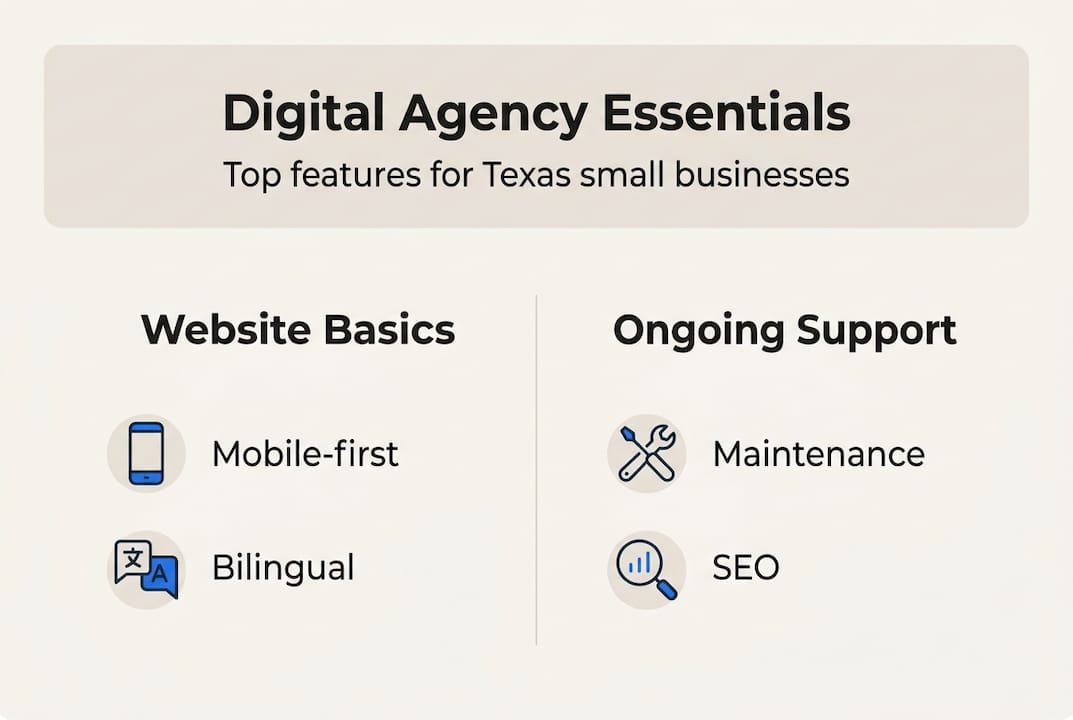
Mobile-responsive design is non-negotiable in 2026. Over 60% of web traffic comes from smartphones and tablets. Sites that load slowly or display poorly on mobile devices lose customers immediately. Quality agencies build mobile-first websites that adapt seamlessly to any screen size, ensuring fast load times and easy navigation. This approach can boost conversion rates by 35% or more compared to desktop-only designs.

Bilingual support matters tremendously in Texas. The state's diverse population includes millions of Spanish-speaking customers actively searching for local services. Agencies offering bilingual website development help you reach this underserved market effectively. Professional translation goes beyond Google Translate, ensuring cultural relevance and natural language that builds trust with Hispanic customers.
Affordable pricing between $2,000 and $5,000 represents the sweet spot for quality small business websites. This range typically includes professional design, mobile-responsive development, basic SEO setup, and initial content creation. Prices below $1,000 often indicate template-based sites with limited customization. Costs above $10,000 usually reflect enterprise features most small businesses don't need.
Local case studies and client reviews provide crucial validation. Agencies with proven Texas success stories, like helping pest control companies grow through SEO, demonstrate real-world results in your market. Check platforms like Clutch, Google Reviews, and the Better Business Bureau for unbiased feedback from actual clients.
Five essential questions to ask potential agencies:
- Can you show me three websites you've built for Texas small businesses in my industry?
- What's included in your base pricing, and what costs extra?
- How do you handle mobile responsiveness and page speed optimization?
- Do you offer bilingual development and content creation?
- What's your typical timeline from contract signing to launch?
Pro Tip: Request a detailed proposal that breaks down exactly what you're paying for. Vague line items like "website development" hide potential surprises. Look for specific deliverables such as "5-page responsive website," "bilingual content for home and services pages," and "3 months hosting included." This transparency indicates an agency that respects your budget and timeline.
Ongoing support separates great agencies from mediocre ones. Websites require regular updates for security, content freshness, and technical maintenance. Agencies offering affordable ongoing services starting around $50 monthly provide better long-term value than those charging hourly for every small update. This predictable cost structure helps you budget accurately while ensuring your site stays secure and current.
Texas-specific expertise also matters. Agencies familiar with local search patterns, regional customer preferences, and Texas business regulations deliver more effective solutions than generic national firms. They understand the competitive landscape in cities like Lubbock, Austin, and Houston, optimizing your site to stand out in local search results.
Finally, evaluate the agency's optimization capabilities. A beautiful website that loads slowly or ranks poorly on Google wastes your investment. Look for agencies that integrate technical SEO, performance optimization, and conversion rate optimization into their standard development process, not as expensive add-ons.
Understanding pricing models and project scopes for small Texas business websites
Pricing transparency determines whether you get excellent value or overpay for your website. Understanding how agencies structure costs helps you budget accurately and avoid surprise expenses.
Project-based pricing sets a fixed cost for defined deliverables. You pay one amount for a complete website including design, development, content, and launch. This model works best for new websites or complete redesigns where requirements are clear upfront. The advantage is budget certainty. The challenge is that changes during development may incur additional fees. Agencies using hybrid methodologies typically offer project-based pricing with a defined number of revision rounds included.
Retainer models charge monthly fees for ongoing services. After your initial website launch, you pay a set amount each month for hosting, security updates, content changes, and technical support. This approach suits businesses needing regular updates or ongoing marketing services. Monthly costs typically range from $50 to $500 depending on service levels and complexity.
Project complexity significantly affects both cost and timeline. A simple five-page brochure website with standard features costs less and launches faster than an e-commerce site with custom functionality. Be realistic about what you actually need. Many small businesses overspend on features they never use. Start with essential pages and functionality, then expand as your business grows.
| Pricing Model | Typical Cost | Best For | Pros | Cons |
|---|---|---|---|---|
| Project-based | $2,000 to $5,000 | New sites, redesigns | Fixed budget, clear scope | Changes may cost extra |
| Monthly retainer | $50 to $500/month | Ongoing updates, marketing | Predictable costs, continuous support | Long-term commitment |
| Hourly consulting | $75 to $200/hour | Specific tasks, troubleshooting | Pay only for time used | Unpredictable total cost |
| Template packages | $500 to $1,500 | Very tight budgets | Lowest upfront cost | Limited customization |
Five tips for negotiating and clarifying pricing:
- Request itemized quotes showing exactly what each deliverable costs
- Ask about payment schedules (typical is 50% upfront, 50% at launch)
- Clarify what happens if you need changes during development
- Understand what's included in ongoing support versus additional charges
- Get everything in writing before signing any agreement
Texas small businesses should set realistic budgets based on their actual needs. A professional, mobile-responsive website with basic SEO typically requires $2,500 to $4,000 for quality results. Trying to cut costs below $2,000 often leads to disappointing outcomes requiring expensive fixes later. Conversely, spending over $8,000 rarely provides proportional value for small businesses unless you need specialized features like custom e-commerce integration or complex database functionality.
Consider total cost of ownership beyond the initial launch. Websites require ongoing maintenance, security updates, and content refreshes to remain effective. Factor in $50 to $150 monthly for these services when budgeting. Agencies offering bundled packages with hosting, security, and support included provide better long-term value than those charging separately for each service.
Timeline expectations should align with pricing and scope. A quality small business website typically takes two to four weeks from contract signing to launch using hybrid methodology. Agencies promising completion in days likely use templates with minimal customization. Projects extending beyond six weeks often indicate scope creep or poor project management. Clarify expected timelines upfront and ask about factors that might cause delays.
Understanding these pricing dynamics empowers you to make informed decisions. The cheapest option rarely delivers the best value, but the most expensive doesn't guarantee superior results. Focus on agencies offering transparent pricing, clear deliverables, and proven results for Texas small businesses at fair market rates. This approach ensures you invest wisely in a website that drives real business growth.
Partner with a trusted Texas digital agency for affordable, modern websites
Your business deserves a professional web presence that attracts customers and drives growth without breaking your budget. Digital Biz Agent specializes in creating affordable, high-quality websites for Texas small businesses, with pricing starting at just $2,000 for complete, mobile-responsive sites. Our bilingual development services help you reach both English and Spanish-speaking customers effectively throughout Texas.
We've helped dozens of local businesses launch modern websites using our proven hybrid methodology, delivering results in as little as one week. Our comprehensive services include professional design, mobile-responsive development, SEO optimization, and ongoing support. Check out our transparent pricing plans starting at $25 monthly for landing pages and $50 monthly for full websites, including hosting and maintenance. View our portfolio of successful Texas projects to see real results from businesses like yours. Contact us today for a free consultation and discover how affordable professional web design can transform your business.
Frequently asked questions
What services do digital agencies typically offer small businesses?
Digital agencies provide website design and development, search engine optimization, content creation, hosting, security, and ongoing maintenance. Most agencies also offer digital marketing services like social media management and email campaigns. The best agencies bundle these services into affordable packages tailored for small business budgets, eliminating the need to coordinate multiple vendors.
How long does a typical small business website project take?
Most small business websites launch within two to four weeks using hybrid project management methodologies. Simple five-page sites can be completed in as little as one week, while more complex projects with custom features may take up to six weeks. The website design process timeline depends on project scope, content readiness, and feedback turnaround.
Why is bilingual support important for Texas small businesses?
Texas has one of the largest Spanish-speaking populations in the United States, representing millions of potential customers. Bilingual websites dramatically expand your market reach and build trust with Hispanic communities. Professional translation ensures cultural relevance and natural language that resonates with Spanish-speaking customers, giving you a competitive advantage over English-only competitors.
How often should I consider redesigning my website?
Most businesses benefit from a complete website redesign every three to five years to keep up with design trends, technology updates, and changing customer expectations. However, you should make smaller updates and content refreshes quarterly to maintain relevance and search engine rankings. Review our website redesign guidance to determine the right timing for your business.
What makes hybrid project management best for small fixed budgets?
Hybrid methodology combines predictable timelines and costs from Waterfall with the flexibility of Agile approaches. This balance prevents the scope creep that can blow budgets while allowing necessary refinements during development. Small businesses get clear deliverables and pricing upfront, plus the ability to provide feedback and make adjustments without derailing the project or incurring excessive additional costs.