
Over 60% of all web traffic now comes from mobile devices, yet Google's mobile-first indexing means your mobile site version determines your search rankings entirely. For small businesses in Lubbock, understanding SEO-friendly design isn't optional anymore. It's the difference between being found by local customers or losing them to competitors who invested in optimized websites that rank higher and convert better.
Table of Contents
- Introduction to SEO friendly design
- Core components of SEO-friendly design
- Local SEO considerations in design
- Common misconceptions and pitfalls in SEO design
- Affordable and practical SEO-friendly web design solutions
- Summary and next steps for small business owners
- Affordable SEO-friendly web design services for Lubbock small businesses
- Frequently asked questions
Key takeaways
| Point | Details |
|---|---|
| SEO-friendly design combines technical optimization, quality content, and user experience to improve search rankings | Small businesses gain competitive advantage through proper implementation of these three interconnected factors |
| Mobile responsiveness and fast page speeds are non-negotiable ranking factors in 2026 | Google prioritizes mobile versions and penalizes slow-loading sites with lower rankings and higher bounce rates |
| Local SEO design features boost visibility for Lubbock businesses searching for nearby services | Location-specific keywords, NAP consistency, and Google My Business integration drive 45% more local traffic |
| Affordable SEO-friendly design options exist for tight small business budgets | Subscription-based plans starting at $50/month make professional SEO-optimized websites accessible to everyone |
| Avoiding common mistakes like keyword stuffing and complex graphics protects your rankings | Simple, clean design with relevant content outperforms flashy websites that sacrifice speed and usability |
Introduction to SEO friendly design
SEO-friendly web design merges technical structure, strategic content placement, and exceptional user experience into one cohesive digital asset. Unlike regular websites that focus solely on aesthetics, SEO-optimized sites are built to communicate effectively with search engines while delivering seamless experiences to human visitors. This dual focus ensures your Lubbock business appears in relevant local searches when potential customers need your services most.
For small businesses competing in saturated markets, SEO separates winners from invisible players. Better search rankings translate directly into increased website traffic, which converts into phone calls, form submissions, and foot traffic to your physical location. When someone in Lubbock searches for services you offer, appearing on page one versus page three means capturing that customer or losing them forever.
The benefits extend beyond visibility. SEO-friendly websites build credibility because consumers trust businesses that rank highly on Google. They also provide better user experiences through faster load times, intuitive navigation, and mobile optimization. These factors reduce bounce rates and keep visitors engaged longer, signaling to search engines that your site deserves even higher rankings.
Local SEO optimizations become especially powerful for regional businesses. By incorporating Lubbock-specific keywords, maintaining consistent business information across directories, and optimizing for "near me" searches, you capture customers actively seeking local solutions. These visitors convert at much higher rates than generic web traffic because they're ready to buy now.
Small business owners face real challenges implementing SEO-friendly design:
- Limited budgets make expensive custom development seem out of reach
- Lack of technical knowledge creates confusion about what actually matters for SEO
- Time constraints prevent learning complex optimization strategies
- Competing priorities push website improvements to the bottom of to-do lists
- Fear of choosing wrong solutions leads to analysis paralysis
Core components of SEO-friendly design
Mobile responsiveness dominates SEO considerations in 2026 because Google uses mobile-first indexing, meaning your mobile site version determines your rankings entirely. Desktop versions become secondary references. If your website doesn't display perfectly on smartphones and tablets, you're automatically penalized regardless of how beautiful your desktop site looks. This isn't just about shrinking content to fit smaller screens.
True mobile responsiveness means touch-friendly buttons, readable text without zooming, properly sized images, and navigation that works with thumbs instead of mouse cursors. Modern website features include responsive design frameworks that automatically adapt layouts based on screen size. Testing your site on actual devices reveals problems invisible on desktop monitors, like buttons too close together or forms requiring excessive scrolling.

Page load speed represents another critical ranking factor. Websites loading within 2 seconds rank higher and retain visitors, while sites taking over 3 seconds experience bounce rate increases exceeding 30%. Every additional second of load time costs you customers and search position. Speed optimization requires compressing images without quality loss, minimizing code bloat, leveraging browser caching, and choosing fast hosting providers.
Pro Tip: Balance visual appeal with loading speed by using optimized images at appropriate resolutions. A stunning hero image that takes 8 seconds to load destroys SEO more than a slightly smaller image loading instantly.
Proper header tag hierarchy clarifies content organization for both search engines and users. Using H1, H2, H3 tags correctly creates logical content structure that improves accessibility and SEO simultaneously. Your H1 tag should contain your primary keyword and appear once per page as the main topic identifier. H2 tags break content into major sections, while H3 tags subdivide those sections further.
Schema markup and optimized images enhance how search engines understand and display your content. Schema provides structured data that powers rich snippets in search results, showing star ratings, prices, availability, and other details directly on Google. Images require descriptive alt text, compressed file sizes, and relevant filenames rather than generic camera codes. These elements seem minor individually but compound into significant ranking advantages.
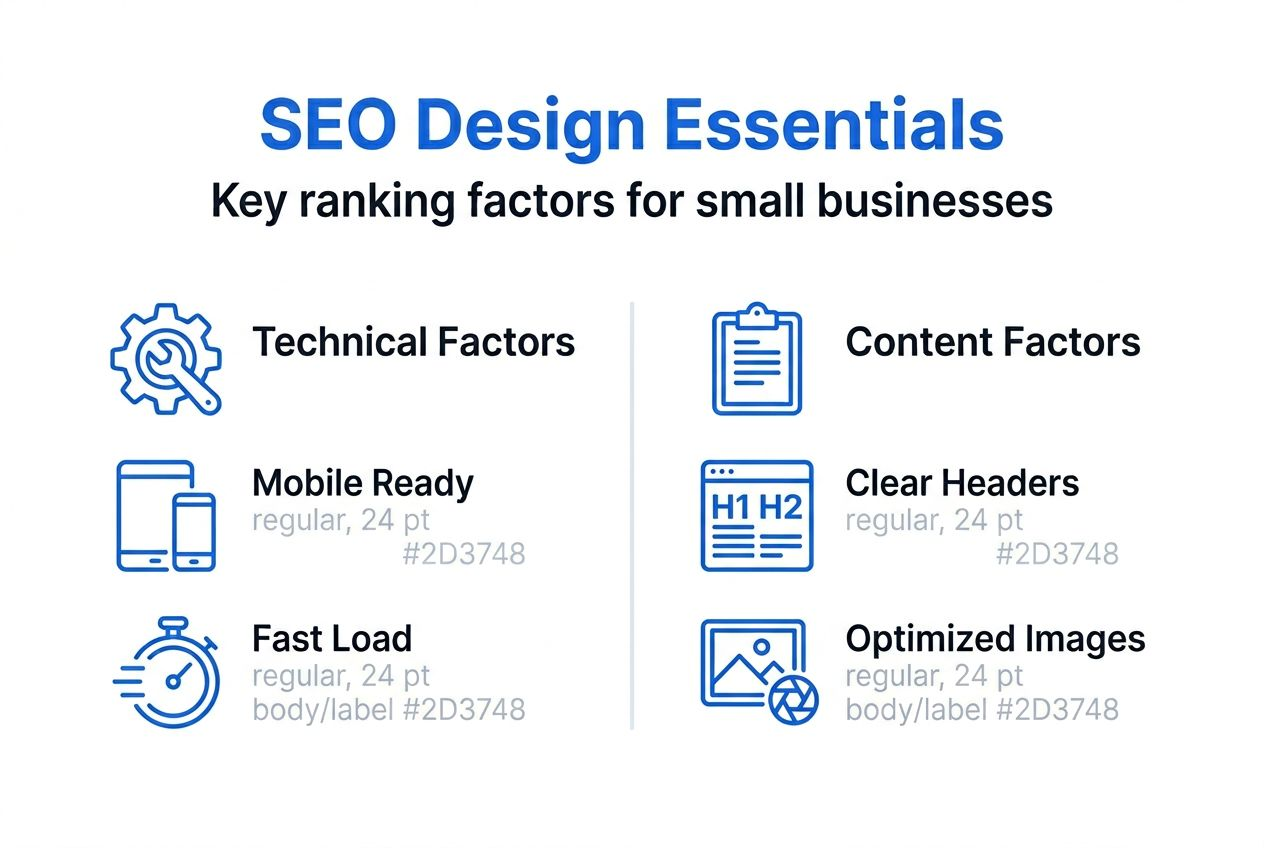
Here's how these components compare in impact and implementation difficulty:
| Component | SEO Impact | Implementation Difficulty | Cost to Fix | Priority Level |
|---|---|---|---|---|
| Mobile Responsiveness | Very High | Medium | $500-2000 | Critical |
| Page Load Speed | Very High | Medium to High | $200-1000 | Critical |
| Header Hierarchy | High | Low | $0-200 | High |
| Schema Markup | Medium | Medium | $100-500 | Medium |
| Image Optimization | Medium | Low | $0-300 | High |
Understanding what every small business website needs and following a comprehensive mobile-responsive checklist ensures you address these core components systematically. Professional websites deliver vital advantages that DIY solutions often miss because they lack technical expertise to implement these elements correctly.
Local SEO considerations in design
Location-specific keywords and consistent NAP data form the foundation of local SEO success. Local SEO strategies boost rankings by incorporating your city, neighborhood, and service area throughout your website naturally. Instead of targeting broad terms like "plumber," Lubbock businesses should optimize for "emergency plumber Lubbock TX" or "West Texas plumbing services." This specificity attracts qualified local traffic instead of irrelevant national visitors.
NAP consistency means your business Name, Address, and Phone number must match exactly across your website, Google My Business profile, Yelp listing, Facebook page, and every other online directory. Even minor variations like "Street" versus "St." or different phone number formats confuse search engines and dilute your local authority. Audit all your online listings quarterly to maintain perfect consistency.
Google My Business integration amplifies local visibility dramatically. Embedding your GMB profile on your website, displaying customer reviews prominently, and linking to your GMB listing creates powerful local signals. Complete your GMB profile entirely, including business hours, service areas, categories, photos, and regular posts. Businesses with fully optimized GMB profiles receive 45% more local search traffic on average.
Designing calls-to-action around local engagement increases conversion rates substantially. Instead of generic "Contact Us" buttons, use location-specific CTAs like "Schedule Your Free Lubbock Area Consultation" or "Call Our South Plains Team Now." Display local phone numbers prominently rather than toll-free numbers. Include maps showing your service area clearly and embed directions from major Lubbock landmarks.
Actionable local SEO design tips for small business owners:
- Add schema markup for LocalBusiness to help Google understand your location and services
- Create dedicated service area pages for each Lubbock neighborhood you serve
- Display local customer testimonials with city names mentioned naturally
- Include Lubbock landmarks and recognizable local references in your content
- Embed Google Maps showing your business location and coverage area
- List local associations, chambers, or community groups you belong to
- Use local phone numbers in headers and footers, not generic 800 numbers
- Create blog content addressing local concerns and Lubbock-specific topics
Professional website design services implement these local optimization strategies from the foundation rather than trying to retrofit them later. Local SEO works best when baked into site architecture and content strategy from day one.
Common misconceptions and pitfalls in SEO design
Many small business owners mistakenly believe SEO depends primarily on backlinks and off-page factors while design plays minimal roles. This outdated thinking from 2010-era SEO ignores how dramatically Google's algorithms have evolved. Today, on-page technical factors, site structure, and user experience signals carry equal or greater weight than backlink profiles. Poor design actively sabotages even the strongest link-building campaigns.
Another dangerous myth suggests flashy graphics and complex animations impress visitors enough to overcome slow load times or poor mobile experiences. Reality proves the opposite. Visitors abandon stunning websites that take 5 seconds to load or don't work on phones. Google's algorithms penalize these sites regardless of visual appeal. Simple, fast, functional design outranks beautiful but broken websites consistently.
Some business owners still optimize primarily for desktop viewing, assuming mobile is secondary. This thinking inverts current reality. Since Google switched to mobile-first indexing, your mobile site version determines your rankings entirely. The desktop version becomes essentially irrelevant for SEO purposes. If your mobile site is broken or non-existent, you cannot rank well regardless of desktop quality.
Keyword stuffing represents another persistent mistake. Cramming your target keyword into every paragraph, headline, and image alt tag triggers spam filters and penalties rather than boosting rankings. Modern SEO requires natural keyword usage focused on user value. Write for humans first, then verify you've included keywords appropriately without forcing unnatural repetition.
Over-complicated design elements hurt SEO in multiple ways:
- Heavy JavaScript frameworks slow page loads and block search engine crawlers
- Excessive plugins create security vulnerabilities and performance issues
- Large uncompressed images waste bandwidth and delay rendering
- Complex navigation structures confuse both users and search algorithms
- Autoplay videos consume data and drive mobile users away immediately
Pro Tip: Prioritize clean, relevant design focused on user needs over trendy gimmicks that sacrifice speed and usability. Test your site on actual customer devices rather than assuming your desktop experience matches reality.
DIY site builders create numerous problems because they lack flexibility to implement proper SEO optimizations. Template limitations, bloated code, and restricted access to technical settings prevent achieving competitive search rankings. What seems cost-effective initially becomes expensive when you realize you need to rebuild everything properly.
Affordable and practical SEO-friendly web design solutions
Traditional custom web design typically costs $5,000 to $15,000 upfront with no guarantee of SEO effectiveness or ongoing optimization. These projects take 8 to 12 weeks minimum and often exceed budgets due to scope creep. For small businesses with limited capital, this investment feels prohibitive and risky. Subscription-based SEO-friendly website plans offer dramatically different economics and outcomes.
Modern subscription models provide professionally designed, fully optimized websites for monthly fees comparable to phone bills. Plans starting at $50/month include hosting, security, maintenance, updates, and ongoing SEO improvements. This approach eliminates massive upfront costs while ensuring your site stays current with algorithm changes and security threats. You're essentially renting expertise rather than buying a depreciating digital asset.
The streamlined process for launching affordable SEO-friendly websites typically follows these steps:
- Initial consultation identifies your business goals, target customers, and competitive landscape.
- Professional designers create your site incorporating proven SEO elements and your brand identity.
- Content specialists write optimized copy targeting relevant keywords and local search terms.
- Technical experts implement schema markup, mobile responsiveness, and speed optimizations.
- Your site launches typically within one week rather than months of back-and-forth revisions.
- Ongoing monitoring and updates keep your site secure, fast, and ranking competitively.
Pricing ranges reflect different business needs and complexity levels:
| Service Level | Monthly Cost | What's Included | Best For | SEO Features |
|---|---|---|---|---|
| Landing Page | $25-40 | Single optimized page, hosting, SSL | Simple lead capture, specific campaigns | Basic on-page SEO, mobile responsive |
| Business Website | $50-100 | Multi-page site, blog, contact forms | Most small businesses | Full technical SEO, local optimization |
| E-commerce Site | $100-150 | Product catalog, payment processing | Online retailers | Product schema, conversion optimization |
| Enterprise Solution | $150+ | Custom features, integrations, priority support | Growing businesses with complex needs | Advanced SEO, competitor analysis, reporting |
Balancing cost with SEO effectiveness requires understanding what actually drives rankings versus nice-to-have features. Core essentials like mobile responsiveness, fast hosting, proper structure, and quality content matter infinitely more than fancy animations or complex layouts. Invest your limited budget in fundamentals first, adding aesthetic enhancements only after solid SEO foundations exist.
Pro Tip: Choose providers offering ongoing SEO and technical support rather than one-time builds. Following comprehensive SEO checklists ensures your designer addresses critical ranking factors systematically.
Professional website design and SEO services combine expertise across technical optimization, content strategy, and conversion design. This integrated approach produces better results than hiring separate specialists who don't coordinate efforts. One team managing all aspects ensures consistency and avoids conflicting implementations that waste money.
Summary and next steps for small business owners
SEO-friendly design delivers measurable business growth through improved search rankings, increased qualified traffic, and higher conversion rates. Small businesses implementing proper optimization strategies consistently outperform larger competitors who neglect technical foundations. Your website becomes a 24/7 sales tool attracting customers actively searching for your services rather than hoping random visitors stumble upon you.
Implementing SEO-friendly design principles doesn't require massive budgets or technical expertise when you partner with specialists who understand small business constraints. Start by auditing your current website against the core components discussed, identifying gaps between your situation and best practices. Prioritize mobile responsiveness and page speed first since these factors impact rankings most dramatically.
Contacting experienced small business SEO-friendly design experts accelerates results while avoiding costly mistakes. Professional designers already know what works, which shortcuts to avoid, and how to maximize limited budgets. They've solved the exact problems you're facing repeatedly and can implement proven solutions faster than you could learn independently.
Next steps for evaluating your current website and choosing affordable services:
- Test your site's mobile responsiveness using Google's Mobile-Friendly Test tool
- Check page speed with PageSpeed Insights and note specific improvement recommendations
- Audit your NAP consistency across all online business listings and directories
- Review your Google My Business profile completion percentage and missing elements
- Compare your site's structure and content against top-ranking local competitors
- Request consultations from 2 to 3 affordable website service providers
- Ask specific questions about their SEO implementation process and ongoing optimization
- Verify they include mobile responsiveness, speed optimization, and local SEO in base packages
Explore affordable website design resources and educational content that helps you understand what quality SEO-friendly websites require. Knowledge empowers better decisions when evaluating potential partners and ensures you recognize value versus empty promises.
Affordable SEO-friendly web design services for Lubbock small businesses
Ready to transform your online presence with a website that actually attracts local customers? Digital Biz Agent specializes in affordable, SEO-optimized websites built specifically for Lubbock small businesses competing in today's mobile-first search environment. Our website design and SEO services deliver professional results without the traditional agency price tags or months-long timelines.
Our transparent pricing plans start at just $50 per month for complete business websites including hosting, security, maintenance, and ongoing SEO improvements. You get mobile-responsive design, fast loading speeds, local optimization, and everything discussed in this guide implemented by experienced professionals. We handle the technical complexity while you focus on running your business.
View our portfolio of successful small business websites to see real results we've delivered for Lubbock area companies. Every site includes the SEO-friendly features that drive rankings and conversions. Schedule your free consultation today and discover how affordable professional web design can accelerate your business growth starting this month.
Frequently asked questions
What distinguishes SEO-friendly design from regular web design?
SEO-friendly design intentionally optimizes technical structure, content placement, page speed, mobile responsiveness, and user experience specifically to rank higher in search results. Regular web design focuses primarily on visual aesthetics and basic functionality without considering how search engines crawl, index, and rank pages. The difference shows in measurable traffic and conversion outcomes.
How does SEO-friendly design impact local business rankings in Lubbock?
Local SEO design incorporates location-specific keywords, consistent NAP data across directories, Google My Business integration, and service area pages targeting Lubbock neighborhoods. These elements signal geographic relevance to search engines, helping your business appear when nearby customers search for your services. Properly optimized local sites receive 45% more targeted traffic than generic websites.
Is SEO-friendly design affordable for small businesses with limited budgets?
Yes, subscription-based website services now offer professionally designed, fully optimized sites starting at $50 per month including hosting, security, and ongoing improvements. This monthly investment costs less than traditional single-page ads while delivering continuous value. You avoid $5,000 to $15,000 upfront custom development costs and get expert ongoing optimization included.
What are simple steps to start making my website more SEO-friendly?
Begin by testing mobile responsiveness and page speed using free Google tools, then fix critical issues first. Ensure your business name, address, and phone number match exactly across all online listings. Add location-specific keywords naturally throughout your content. Verify your Google My Business profile is 100% complete with photos, hours, and services listed accurately.
How important is mobile responsiveness for SEO in 2026?
Mobile responsiveness is absolutely critical because Google uses mobile-first indexing exclusively, meaning your mobile site version determines all your search rankings. Desktop versions become irrelevant for ranking purposes. If your site doesn't work perfectly on smartphones, you cannot achieve competitive search positions regardless of other optimization efforts. Over 60% of searches now occur on mobile devices.
Recommended
- Professional Website Design for Small Businesses Starting at $25/Month
- Mobile-responsive website checklist for Texas businesses 2026
- 8 Things Every Small Business Website Needs - JAMES PEREZ
- Modern website features list: 30% more engagement for SMBs
- SEO Checklist for Web Designers 2026: Boost Accuracy 25%