
TL;DR:
- Quick website turnaround involves completing all development stages in 3 days to 4 weeks without sacrificing quality.
- Speed is crucial for Texas small businesses to gain local advantage, capitalize on seasonal events, and meet customer expectations.
- Successful fast launches depend on clear goals, prepared content, streamlined communication, and ongoing post-launch engagement.
Many Texas small business owners assume that if a website gets built fast, something must be getting cut. That's not true. Quick turnaround in web design means completing the full delivery cycle from first conversation to live site in a compressed timeframe, without skipping the steps that matter. For Texas entrepreneurs juggling inventory, customers, and payroll, waiting three months for a website isn't realistic. Speed and quality can work together when the right process and team are in place.
Table of Contents
- Defining quick website turnaround: What it really means
- Why speed matters for Texas small businesses
- How quick website turnaround works: Steps and best practices
- Quick turnaround vs. traditional web design: A side-by-side comparison
- What most SMBs miss about quick website turnaround
- Get started with quick, affordable website solutions
- Frequently asked questions
Key Takeaways
| Point | Details |
|---|---|
| Quick turnaround defined | Quick website turnaround means delivering a complete site in just days by streamlining every step. |
| Speed boosts competitiveness | A fast web launch helps Texas small businesses capture more customers and market opportunities. |
| Quality remains possible | Swift turnaround does not require sacrificing quality if planning and communication are strong. |
| Success requires preparation | Having all your materials ready and collaborating closely with your designer ensures the fastest result. |
Defining quick website turnaround: What it really means
Not every business owner has worked with a web agency before, so the phrase "quick turnaround" can mean different things to different people. Let's get specific.
In web development, turnaround refers to the action and process of receiving a request, processing it through all required stages, and returning a finished product. In plain terms, it's the time between "we want a website" and "your website is live." For small business projects, that cycle can realistically range from 3 days to 4 weeks, depending on size and complexity.
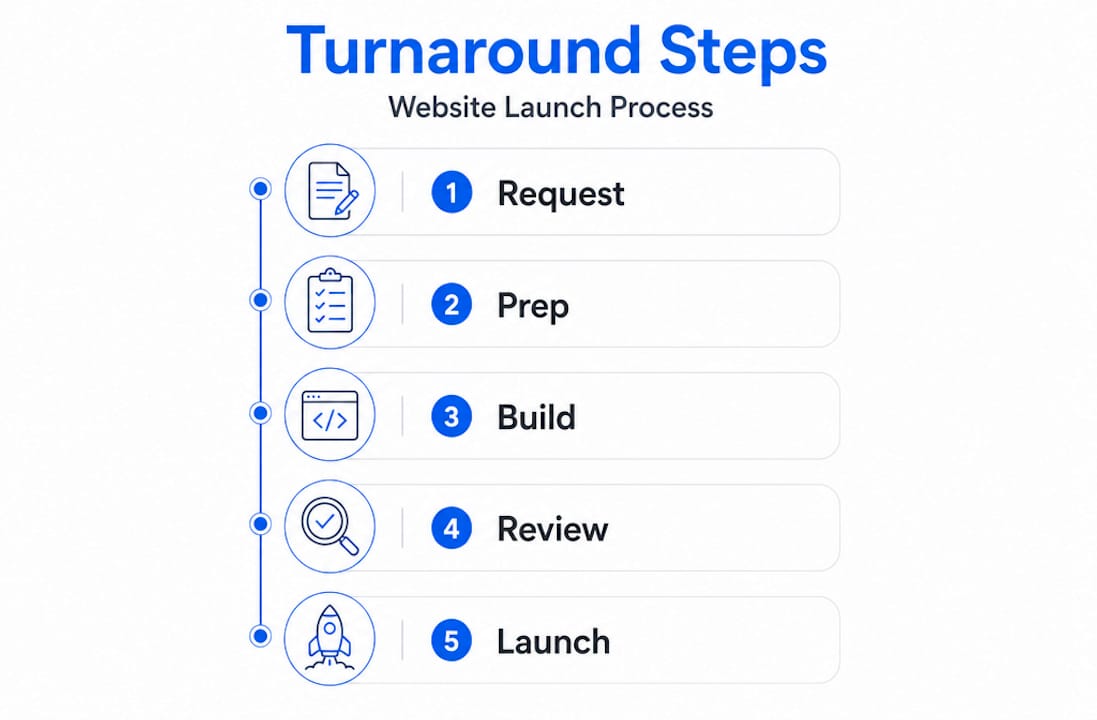
Here's how typical timeframes break down:
| Project type | Typical turnaround |
|---|---|
| Single landing page | 3 to 5 days |
| Simple 3 to 5 page website | 7 to 10 days |
| Full business website with forms, gallery, bilingual content | 2 to 4 weeks |
| E-commerce or custom features | 4 to 8 weeks |
These numbers assume the client is responsive and provides content quickly. Delays in feedback or missing materials are the number one reason quick projects stretch out.
The stages involved in a fast web project are:
- Discovery and planning: Understanding your goals, audience, and required features
- Design and prototype: Creating a visual layout for review
- Development: Building out the site with real content
- Review and revisions: Client feedback and final adjustments
- Launch and handoff: Going live and transferring access
Each stage feeds into the next. If you know what key website essentials you need before the project starts, you cut the planning stage in half.
"Quick turnaround is not about rushing. It's about removing friction from every step of the process so nothing gets stuck."
Clear communication drives speed. When clients know exactly what to expect and come prepared, the process moves quickly. When expectations are vague, every stage slows down.
Why speed matters for Texas small businesses
With the definition established, let's look at why quick turnaround is especially important for Texas small businesses specifically.
Texas is one of the most economically active states in the country. Small businesses here face pressure from large chains, national e-commerce platforms, and a constantly shifting customer base. If you don't have a working website when a customer searches for you, they find your competitor instead. That's not a theory. It's what happens every day.
Here are the core reasons speed is critical for Texas SMBs:
-
First-mover advantage in local markets. If two taco shops open in the same neighborhood, the one with a working website first gets found first in Google searches. Local SEO rewards active, established sites.
-
Seasonal and event opportunities. Texas has a packed calendar of festivals, rodeos, holidays, and tourism seasons. A website needs to be live before the event, not after. Missing the Lubbock Cotton Festival or San Antonio's holiday shopping season by even two weeks costs real revenue.
-
Bilingual reach expands your customer base fast. Texas has a large and growing Spanish-speaking population. A bilingual site doesn't just add a Spanish page. It signals to a whole community that your business respects and serves them. That trust converts to customers faster than any ad campaign.
-
Customer expectations have changed. Shoppers now search before they visit. If your site isn't live and functional, many potential customers assume you aren't open, aren't serious, or don't exist.
-
Responsive agility during market shifts. Texas markets can shift quickly due to weather events, population growth, and economic changes. A business that can launch a new website or update its online presence in days can react to those shifts. One that waits months cannot.
Pro Tip: If your website needs bilingual content, assign one bilingual point of contact on your team to review Spanish translations before launch. This avoids miscommunication delays and keeps your content accurate for your audience.
If you're already noticing customers asking where your site is or struggling to find your hours and address online, those are clear signs you need a new site right now. And if you already have a site but it feels outdated, understanding website redesign timing will help you plan your next move.
A quick turnaround is not just a convenience. For Texas small businesses competing in fast-moving local markets, it's a direct competitive advantage that affects revenue, visibility, and long-term brand trust.
How quick website turnaround works: Steps and best practices
Understanding why timing matters leads naturally to how the process actually works, step by step.
A streamlined delivery cycle from start to launch is achievable when everyone involved knows the process and stays on track. Here's how a fast, quality web build typically flows:
-
Initial consultation. You share your business goals, target audience, and what you want the website to accomplish. This should take one focused conversation, not weeks of back and forth.
-
Free demo or prototype. A visual mockup gets created so you can see the look and feel before any real development begins. You give feedback at this stage, not after hours of development work are already done.
-
Content collection. This is where most projects slow down. You need to provide your business name, logo, photos, service descriptions, contact information, and any bilingual copy. The faster you hand this over, the faster your site gets built.
-
Design and development. The actual site gets built using your approved prototype and content. A mobile-friendly design workflow ensures the site looks good and works correctly on phones, tablets, and desktops from the start.
-
Review and revisions. You review the live staging site and request any changes. Keep revision requests consolidated into one clear list to avoid back and forth.
-
Launch. The site goes live. DNS settings update, hosting is confirmed, and your URL is active. This step can happen within hours of final approval.
Best practices that protect quality during a fast build:
- Use a pre-approved design framework so the team isn't starting from scratch
- Limit revision rounds to keep the project on schedule
- Set clear deadlines for content submission before the project starts
- Use a staging environment so the live site is only touched when it's ready
- Follow professional design standards to ensure the final product represents your brand correctly
Pro Tip: Prepare all your content before the kickoff call. That means your logo files, at least 5 to 10 business photos, a written description of your services, and your preferred contact details. Handing this over on day one can cut your launch time by several days.
The biggest myth about fast websites is that corners are cut. In reality, the team working on your site is simply removing unnecessary delays, not necessary steps.

Quick turnaround vs. traditional web design: A side-by-side comparison
Once you understand the process, it helps to compare quick turnaround with a traditional web design approach so you can choose what fits your situation.
A shorter delivery cycle can process and return a completed website efficiently, unlike traditional models that add multiple approval layers and extended timelines. Here's how they compare directly:
| Factor | Quick turnaround | Traditional agency |
|---|---|---|
| Timeline | 3 days to 4 weeks | 2 to 6 months |
| Cost | Often lower, starting at $25/month | Higher, often $3,000 to $15,000+ upfront |
| Design flexibility | Template-based with customization | Fully custom from scratch |
| Communication | Direct and fast | Multiple departments, slower responses |
| Quality assurance | Built into each stage | Formal QA phases add time |
| Post-launch support | Usually included | Often billed separately |
| Ideal for | SMBs, startups, fast campaigns | Large brands with complex needs |
When quick turnaround is the right choice:
- You're a startup or new business that needs a site live before you open
- You're running a time-sensitive promotion or seasonal campaign
- You have a limited budget and need a professional result quickly
- You want bilingual support without a long back and forth process
- You need a simple, clean site that gets updated and grows over time
When traditional web design may make more sense:
- You're a large organization with complex custom functionality
- You need a fully custom e-commerce platform with unique integrations
- Your project requires months of research, branding, and strategy work
For most Texas small businesses, understanding why websites matter is the first step. The second step is recognizing that a modern, fast-launched site with modern web features can accomplish everything a small business needs, without the six-month wait or the five-figure price tag.
Traditional agencies are not better by default. They're just slower and more expensive. For a solo plumber in El Paso or a family-owned bakery in Houston, that model doesn't serve the real need.
What most SMBs miss about quick website turnaround
Here's what we've seen after working with small business owners across Texas. Most of them focus entirely on one question: how fast can we go live? That's the wrong question to lead with.
Speed without strategy doesn't get you customers. It gets you a live URL that nobody finds and nobody trusts. We've seen businesses launch in four days and see real inquiries within two weeks, and we've seen others launch just as fast and get nothing, because they had no clear goal for what the website was supposed to do.
The real differentiator isn't the number of days until launch. It's how clearly you can answer these questions before the project starts: Who is your customer? What do you want them to do on your site? What makes your business different? If you can't answer those clearly, no turnaround time will fix that.
The second thing most business owners miss is the post-launch phase. A website that launches fast but receives no updates, no maintenance, and no ongoing support becomes a liability within six months. Search engines deprioritize stale sites. Security vulnerabilities go unpatched. Contact forms break. The site that felt like a victory on launch day becomes an embarrassment a year later.
At Digital Biz Agent, we've learned that the businesses that get the most from a fast launch are the ones that stay engaged afterward. They update their service pages. They add photos. They check in when something feels off. That ongoing relationship is what turns a fast website into a long-term business asset.
Read more about real experiences and local results on our blog, where we share practical stories from Texas small business owners who've been through this process.
Get started with quick, affordable website solutions
You've seen how quick turnaround works and what it can do for your Texas business. Now here's how to put that knowledge into action.
Digital Biz Agent offers website services in Texas built specifically for small business owners who need a professional result without a long timeline or a big upfront cost. We offer full bilingual support in English and Spanish, which means your site speaks to every customer in your market. Our pricing for small business websites starts at $25 per month for landing pages and $50 per month for full websites, with no large upfront payments required. We build, host, maintain, and secure your site. You stay focused on running your business. Check out our website examples to see what a fast, professional launch looks like in practice.
Frequently asked questions
How fast can a website really be launched with quick turnaround?
With good preparation, a website can launch in as little as 3 to 7 days, since quick turnaround means receiving, processing, and returning a completed site swiftly. The main factor that determines launch speed is how quickly you provide your content and feedback.
Does quick turnaround mean lower quality websites?
No. Speed does not require cutting corners when smart planning and clear communication are in place from the start. Efficient turnaround can still produce a complete, polished, and fully functional website.
Can a bilingual website be created quickly for Texas audiences?
Yes. With the right content prepared in both English and Spanish, a bilingual site can launch on the same fast timeline as a single-language site. The key is having your translated content ready before the build begins.
What do I need to provide for a fast website launch?
Have your business name, logo, photos, service descriptions, and contact information ready before you start. Preparation of all materials is the single most effective way to accelerate the entire launch process.