Your website is often the first handshake with potential customers, and research shows that 94% of first impressions relate to design. For Texas small business owners, understanding what professional web design truly means can be the difference between a site that attracts customers and one that drives them away. Professional web design isn't just about pretty colors or fancy animations. It's a strategic process that combines aesthetics, usability, performance, and business goals to create websites that convert visitors into loyal customers. This guide breaks down the core process, best practices, and real ROI data so you can make informed decisions about your online presence.
Table of Contents
- Understanding professional web design: More than just looks
- The professional web design process: Step-by-step for Texas entrepreneurs
- Key principles and expert nuances that elevate your website
- Why professional web design offers the best ROI for Texas small businesses
- Get professional website design that drives Texas business growth
Key takeaways
| Point | Details |
|---|---|
| Professional design definition | A structured process blending visual appeal, usability, accessibility, performance, and business goals to deliver effective user experiences. |
| Five core design phases | Discovery and strategy, planning, design, development, and launch with optimization ensure quality results. |
| Critical design principles | User-centric approach, visual hierarchy, responsive layout, fast performance, accessibility, and trust signals drive conversions. |
| Empirical ROI benchmarks | Professional sites show 53% higher success rates, 245-485% ROI, and 20-45% conversion lifts compared to DIY approaches. |
| DIY versus professional trade-offs | DIY builders offer speed and low cost but lack customization, while professional design delivers optimized, scalable solutions. |
Understanding professional web design: More than just looks
Professional web design is the structured process of planning, creating, and optimizing websites that blend visual appeal, usability, accessibility, performance, and business goals to deliver effective user experiences. Many Texas entrepreneurs mistakenly think web design only involves choosing colors and fonts. In reality, it's a comprehensive discipline that addresses how your site functions, how quickly it loads, how easily visitors find information, and whether it builds trust with your target audience.
User experience sits at the heart of professional design. Your website must guide visitors smoothly from their first click to conversion, whether that's making a purchase, booking a consultation, or calling your business. For small businesses competing in Texas markets, this means your site needs to communicate value instantly, load in under three seconds, and work flawlessly on mobile devices where most browsing happens.
Professional design encompasses multiple interconnected components:
- User interface design creating intuitive navigation and visual appeal
- User experience architecture mapping customer journeys and conversion paths
- Search engine optimization ensuring your site ranks for relevant local searches
- Mobile responsiveness adapting seamlessly to phones, tablets, and desktops
- Performance optimization delivering fast load times and smooth interactions
- Trust signals including security badges, testimonials, and professional photography
Accessibility and performance aren't optional extras. They're fundamental requirements that affect both your search rankings and how real customers interact with your business online. A professionally designed site considers visitors with disabilities, ensuring everyone can access your services. It also prioritizes website design terminology that resonates with your specific audience, avoiding jargon that confuses potential customers.
Professional web design creates digital experiences that not only look polished but function strategically to achieve measurable business outcomes, from lead generation to revenue growth.
For Texas small businesses, professional design means your website works as hard as you do, turning casual browsers into paying customers around the clock.

The professional web design process: Step-by-step for Texas entrepreneurs
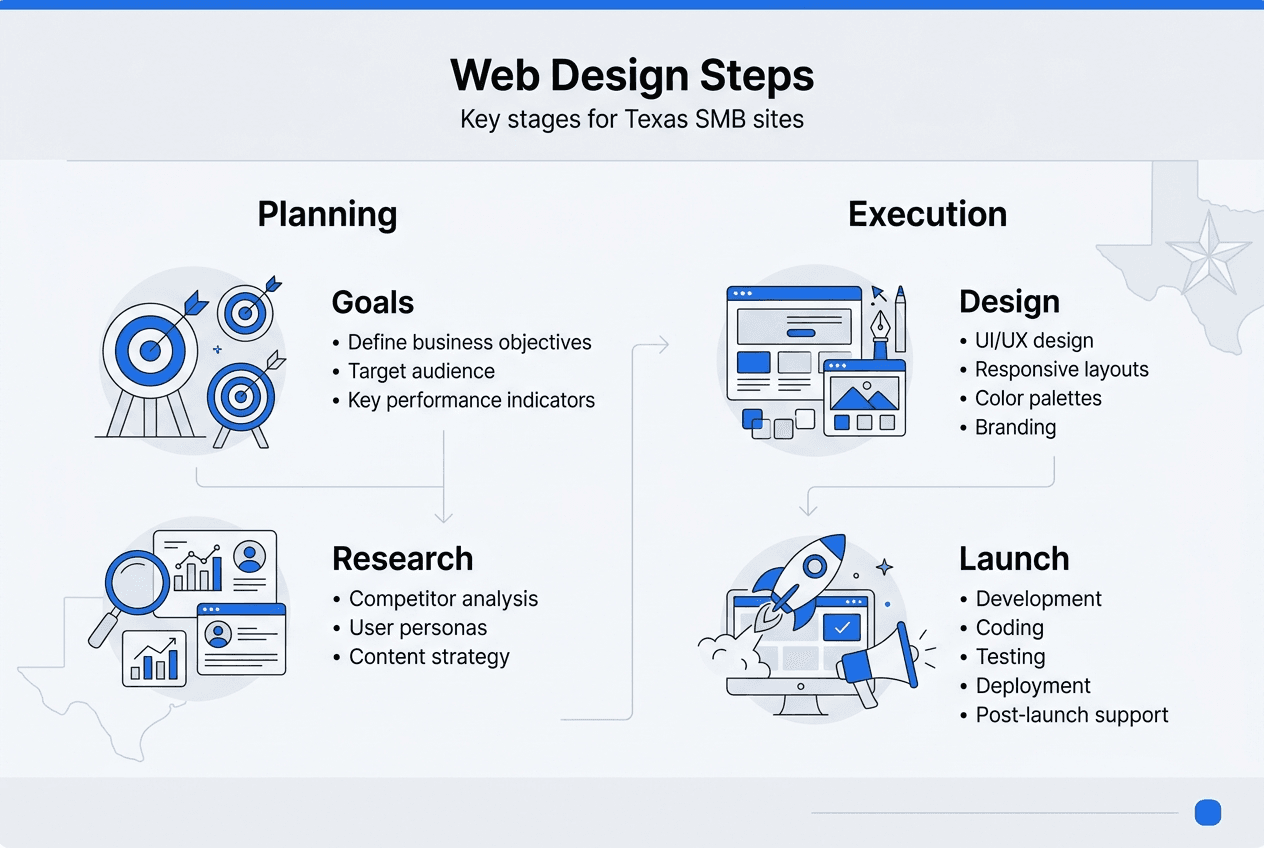
Understanding how professionals approach web design helps you set realistic expectations and recognize quality work. The structured methodology includes discovery and strategy, planning, design, development, and launch phases, each contributing essential elements to your final website. This systematic approach ensures nothing gets overlooked and your site aligns with actual business goals rather than just looking nice.
The professional 7-step process includes research, strategy, wireframing, visual design, prototyping, build, and launch, creating a roadmap from concept to live site:
- Discovery and research phase where designers interview you about business goals, target customers, competitors, and unique value propositions
- Strategy development defining site architecture, content requirements, conversion goals, and technical specifications
- Wireframing to map page layouts, navigation flow, and user pathways without visual distractions
- Visual design applying your brand colors, typography, imagery, and style to create the polished look
- Prototyping and testing to validate designs with real users before expensive development begins
- Development and coding to build functional pages with clean code, integrations, and performance optimization
- Launch and optimization including final testing, search engine setup, analytics installation, and ongoing improvements
Pro Tip: Start your design project by documenting three specific business goals your website must achieve, like generating 20 qualified leads monthly or reducing customer service calls by 30%. This clarity helps designers create solutions that deliver measurable ROI rather than just aesthetic appeal.
The difference between DIY and professional approaches becomes clear when comparing processes side by side:
| Aspect | DIY Approach | Professional Process |
|---|---|---|
| Research phase | Skip or minimal | Comprehensive audience and competitor analysis |
| Strategy | Template selection | Custom architecture based on business goals |
| Design | Pre-made themes | Tailored visual identity and user experience |
| Testing | Limited or none | Multi-device and user testing before launch |
| Optimization | Basic or absent | Performance tuning, SEO setup, conversion optimization |
| Timeline | 1-3 days | 2-8 weeks depending on complexity |
Each phase in the professional process builds upon previous work, creating websites that function as complete marketing systems rather than simple online brochures. For Texas small businesses, this means your site becomes a 24/7 sales tool that consistently attracts, engages, and converts your ideal customers. The website design process texas SMBs follow ensures local market nuances get addressed, from mobile-first design for on-the-go customers to local SEO optimization for geographic searches.
Key principles and expert nuances that elevate your website
Professional designers apply fundamental principles that separate effective websites from mediocre ones. Key principles include user-centric design, visual hierarchy, consistency, responsive and mobile-first approach, fast performance, accessibility, clear calls to action, and trust signals that guide every design decision. These aren't arbitrary rules but proven frameworks that improve usability and conversion rates across industries.
User-centric design means every element serves your visitor's needs first. Navigation must be intuitive, content must answer their questions, and conversion paths must feel natural rather than pushy. Visual hierarchy uses size, color, contrast, and spacing to guide eyes toward the most important information, ensuring visitors see your key messages before less critical details. Consistency across pages builds familiarity and trust, while responsive design ensures your site works beautifully whether someone visits from an iPhone, Android tablet, or desktop computer.
Core principles that drive results:
- Mobile-first approach designing for small screens first, then scaling up for larger devices
- Performance optimization keeping load times under three seconds to prevent visitor abandonment
- Clear calls to action using contrasting colors and action-oriented language to guide conversions
- White space utilization preventing cluttered layouts that overwhelm and confuse visitors
- Typography hierarchy making content scannable with clear headings and readable body text
- Color psychology choosing palettes that evoke appropriate emotions for your brand and industry
Beyond basic principles, professionals employ expert nuances like font optimization, focus states, visually-hidden classes, and keyboard shortcuts that enhance accessibility and performance. Font optimization involves loading only necessary font weights and using modern formats that reduce file sizes by 50% or more. Focus states ensure keyboard users can navigate your site effectively, critical for accessibility compliance. These technical details might seem minor, but they significantly impact how search engines rank your site and how real people experience it.
Accessibility matters tremendously for Texas small businesses. Beyond legal compliance, accessible design expands your potential customer base to include the 26% of Americans with disabilities. Simple improvements like sufficient color contrast, descriptive link text, and proper heading structure make your site usable for everyone while simultaneously improving your search rankings.
Pro Tip: Test your website's Core Web Vitals monthly using Google's PageSpeed Insights tool and verify WCAG 2.1 Level AA compliance with automated scanners. These metrics directly influence your search rankings and user satisfaction, making them essential monitoring points for any business serious about online growth.
The web design guide texas SMBs reference provides deeper exploration of these principles with local market applications, helping you understand what separates amateur sites from professional ones that drive consistent business results.
Why professional web design offers the best ROI for Texas small businesses
Investing in professional web design delivers measurable returns that far exceed the initial cost. Professional sites show 53% higher success rates, redesign ROI of 245-485% with break-even periods of 6-11 months, and conversion lifts of 20-45% compared to DIY approaches. For Texas small businesses operating on tight budgets, understanding these numbers helps justify the investment and set realistic expectations for results.
Cost ranges for professional web design in Texas typically span from $3,000 for basic small business sites to $25,000 for complex e-commerce or custom applications. Monthly maintenance and hosting add $50 to $500 depending on your needs. While these figures might seem substantial compared to $10 monthly DIY builders, the return on investment tells a different story.
| Metric | DIY Approach | Professional Design |
|---|---|---|
| Initial cost | $0-$500 | $3,000-$25,000 |
| Monthly costs | $10-$30 | $50-$500 |
| Average conversion rate | 0.5-1.5% | 2-5% |
| Mobile performance | Poor to fair | Excellent |
| Search ranking potential | Limited | High |
| Customization options | Minimal | Unlimited |
| Time to launch | 1-3 days | 2-8 weeks |
| Break-even timeline | N/A | 6-11 months |
| 3-year ROI | Negative to break-even | 245-485% |
The comparison between DIY and professional approaches reveals that DIY builders offer speed and low upfront costs but deliver generic results with limited growth potential. Professional design requires higher initial investment but provides custom solutions optimized for your specific business goals, target audience, and competitive landscape.
Business benefits from professional web design extend beyond direct revenue:
- Credibility boost with 75% of users judging business legitimacy based on website quality
- Competitive advantage in local markets where many small businesses still use outdated sites
- Time savings by eliminating the learning curve and technical troubleshooting DIY requires
- Scalability allowing your site to grow alongside your business without rebuilding from scratch
- Expert support providing ongoing maintenance, security updates, and performance optimization
- Search visibility improvements driving consistent organic traffic from Google and Bing
Professional web design isn't an expense but an investment that generates compounding returns through increased visibility, higher conversion rates, and enhanced credibility that attracts premium customers willing to pay full price.
For growth-focused Texas entrepreneurs, professional design becomes essential infrastructure rather than optional luxury. Your website works 24/7 to attract customers, answer questions, and generate leads while you focus on delivering excellent products and services. The reasons why DIY site builders are bad for serious businesses become clear when you examine long-term growth potential and total cost of ownership over three to five years.
Get professional website design that drives Texas business growth
Ready to transform your online presence with professional web design that delivers real business results? Digital Biz Agent specializes in creating affordable, high-quality websites for Texas small businesses, combining strategic design with search engine optimization to help you attract more customers and grow revenue. Our team understands the unique challenges local entrepreneurs face and builds solutions that fit your budget without sacrificing quality.
We offer flexible website pricing plans starting at just $25 monthly for landing pages and $50 monthly for full websites, making professional design accessible for businesses at any stage. Our streamlined process delivers modern, mobile-responsive sites in as little as one week, complete with hosting, security, and ongoing support. Explore our comprehensive website design & SEO services to see how we help Texas businesses establish credible online presences that convert visitors into customers. Learn about optimal timing in our website redesign guide to keep your site performing at peak effectiveness as your business evolves.
What questions do Texas small business owners often ask about professional web design?
How much does professional web design cost for small businesses in Texas?
Professional web design in Texas typically ranges from $3,000 to $25,000 depending on complexity, features, and customization needs. Basic small business sites with 5-10 pages cost $3,000 to $8,000, while e-commerce or custom applications range higher. Monthly maintenance and hosting add $50 to $500, covering updates, security, backups, and performance monitoring.
How long does the design process typically take?
Most professional web design projects take 2 to 8 weeks from initial consultation to launch. Simple sites with clear requirements and ready content can launch in 2-3 weeks, while complex projects requiring custom functionality, extensive content creation, or multiple revision rounds may extend to 8-12 weeks. Timeline depends heavily on how quickly you provide feedback, content, and approvals during the process.
Can I use DIY builders and still grow effectively?
DIY builders work for very basic needs but severely limit growth potential through generic templates, poor SEO capabilities, slow performance, and minimal customization options. Most businesses outgrow DIY platforms within 12-18 months as they need custom features, better conversion optimization, or improved search rankings. Starting with professional design saves the cost and disruption of rebuilding later when growth demands better infrastructure.
What maintenance is needed after launch?
Websites require ongoing maintenance including security updates, plugin updates, content refreshes, performance monitoring, backup management, and uptime monitoring. Professional maintenance plans typically cost $50 to $500 monthly depending on site complexity and support level. Regular maintenance prevents security breaches, keeps your site running smoothly, and ensures continued search engine visibility through fresh content and technical optimization.
How often should I redesign my website?
Most businesses benefit from complete redesigns every 2-3 years to keep pace with design trends, technology changes, and evolving customer expectations. Between full redesigns, implement smaller updates quarterly to refresh content, add new features, and optimize conversion paths. Signs you need a redesign include declining traffic, poor mobile performance, outdated branding, or conversion rates below industry benchmarks for your sector.