Many Texas small business owners believe custom website design requires a huge budget and months of waiting. That assumption keeps them stuck with generic templates that fail to capture their brand or connect with local customers. In reality, affordable custom design solutions exist that deliver mobile responsiveness, SEO optimization, and bilingual support without breaking the bank. This guide walks you through the complete process, key features, and practical steps to launch a high-performing website tailored to your business goals and Texas market needs.
Table of Contents
- Key Takeaways
- Understanding the custom website design process
- Key features: mobile responsiveness, SEO optimization, and bilingual support
- Comparing custom website design with templates: what Texas SMBs should consider
- Applying a structured, agile approach to ensure success for your business website
- Explore affordable custom website design services for Texas small businesses
- FAQ
Key Takeaways
| Point | Details |
|---|---|
| Affordable custom design | Affordable design solutions deliver mobile responsiveness, SEO optimization, and bilingual support for Texas small businesses. |
| Mobile responsive design | A site that adapts across devices with fast load times improves usability and conversions. |
| SEO focused build | SEO foundations and a hybrid approach improve speed and rankings. |
| Bilingual site support | Providing bilingual content helps Texas audiences engage and convert. |
| Structured design process | A structured path from strategy to post launch over 90 days maximizes ROI and minimizes revisions. |
Understanding the custom website design process
Custom website design follows a structured process starting with commercial strategy definition, sitemap building around buyer decisions, wireframing, design of conversion journeys, content creation, development with SEO foundations, launch, and post-launch optimization over 90 days. Understanding each stage helps you collaborate effectively with designers and ensures your website aligns with business goals.
-
Define your commercial strategy and target audience. Start by clarifying who you serve, what problems you solve, and how your website will support sales. This foundation shapes every design decision and prevents costly revisions later.
-
Build a sitemap focused on buyer decisions. Map out pages and navigation based on how customers move through your sales funnel. Prioritize clarity over complexity to guide visitors toward conversion actions.
-
Create wireframes to lay out conversion journeys. Wireframes are simple blueprints showing where elements like headlines, calls to action, and forms appear. They help you visualize user flow before investing in visual design.
-
Design content and visuals aligned with branding and SEO goals. Develop messaging that speaks directly to your Texas audience while incorporating keywords naturally. Visual design should reinforce your brand identity and make navigation intuitive.
-
Develop with SEO best practices and ensure mobile responsiveness. Build the site with clean code, fast load times, and responsive layouts that adapt to any screen size. This stage also includes setting up analytics and tracking.
-
Launch after thorough QA testing, then optimize post-launch. Test across browsers and devices to catch issues before going live. After launch, monitor performance metrics and refine elements over 90 days to improve conversions.
This website design process for Texas small businesses ensures you avoid common mistakes like launching without testing or neglecting post-launch optimization. Each step builds on the previous one, creating a cohesive strategy that delivers measurable results.
Pro Tip: Involve your team early in the wireframe stage to gather feedback before design begins. This saves time and ensures the final product meets operational needs.
Key features: mobile responsiveness, SEO optimization, and bilingual support
Three features separate high-performing Texas business websites from forgettable ones. Mobile responsiveness, SEO optimization, and bilingual support directly impact how customers find, experience, and engage with your site.
Mobile responsiveness ensures fast load times, fluid layouts, and usability across devices. Your site must load in under 2.5 seconds and adapt seamlessly to smartphones, tablets, and desktops. Mobile-first responsive design using media queries and fluid layouts prevents frustration and keeps visitors engaged. Poor mobile performance drives customers straight to competitors.
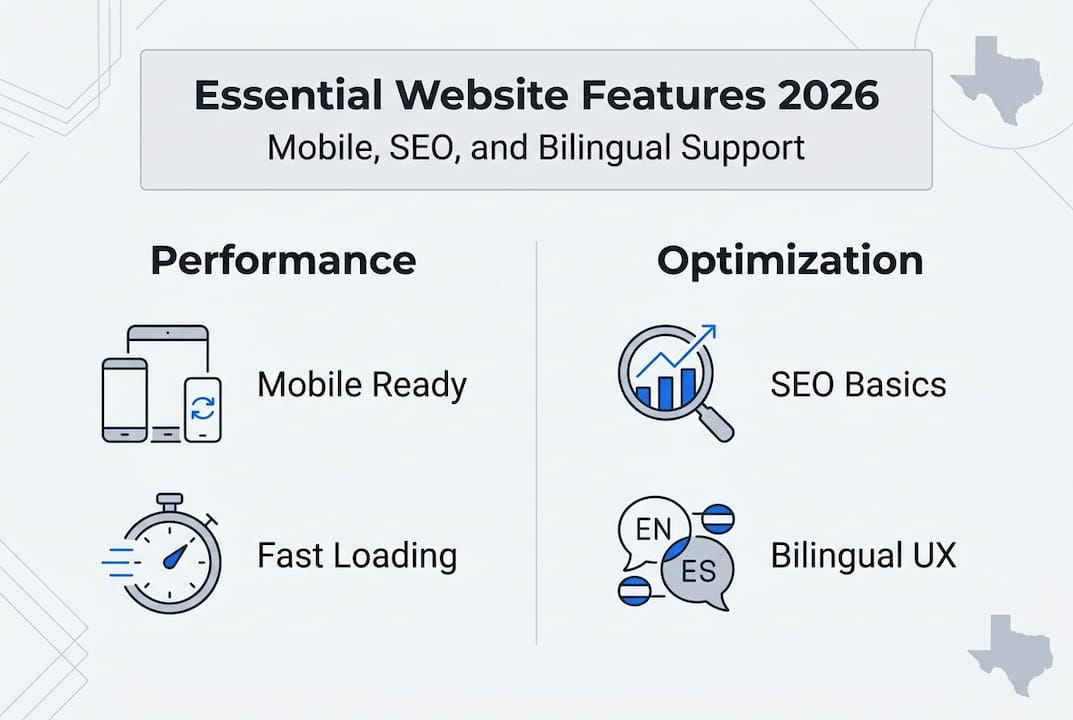
SEO optimization includes foundational on-page factors and hybrid approaches for speed and ranking. Hybrid WordPress and custom HTML solutions balance ease of management with superior performance. This approach delivers faster page speeds and better search rankings than template-only sites. Proper SEO foundations built during development save thousands in future optimization costs.
Bilingual sites require content parity, accessibility compliance, and proper UX for language switching. Texas businesses serving Spanish-speaking communities must offer equal quality across both languages. This means translating all content, maintaining consistent navigation, and making language switching obvious and easy. Content parity builds trust and expands your addressable market significantly.
QA testing is critical to prevent traffic loss and ensure cross-browser consistency. Rigorous testing prevents 40-70% traffic loss post-redesign by catching issues before they impact real customers. Test on Chrome, Firefox, Safari, and Edge across desktop and mobile devices. Check forms, navigation, and checkout flows to ensure everything works perfectly.
Progressive enhancement guarantees core site functions without relying on JavaScript or CSS. This resilience approach ensures your site remains functional even when scripts fail to load. Core content and navigation work in any environment, then enhanced features layer on top for modern browsers. This strategy protects your investment and maximizes accessibility.
Pro Tip: Prioritize mobile-first design and multi-language testing early in the development cycle to save costs and improve user experience. Catching issues during development costs far less than fixing them post-launch.
Explore this mobile-responsive website checklist to ensure your site meets current standards. Pair it with this SEO-friendly design guide for comprehensive optimization. For bilingual sites, review strategies from a local web agency specializing in bilingual websites to ensure proper implementation.
Comparing custom website design with templates: what Texas SMBs should consider
Templates are faster and cheaper for simple needs, but custom design is essential for unique branding, scalability, and SEO optimization using hybrid WordPress and custom HTML. Understanding when each approach makes sense helps you invest wisely.
Templates offer speed and cost savings for simple websites but limit customization and unique branding potential. You can launch quickly with minimal upfront investment, making templates attractive for very basic informational sites. However, templates restrict your ability to stand out in competitive Texas markets where differentiation matters.

Custom design supports scalability, tailored SEO, and bilingual support critical for Texas SMBs targeting diverse local markets. As your business grows, custom sites adapt without requiring complete rebuilds. They also provide the flexibility to implement advanced features like customer portals, booking systems, or e-commerce integrations.
Hybrid approaches leverage template ease with custom performance improvements. Starting with a solid framework and customizing key elements offers a middle path. This strategy reduces development time while still delivering unique branding and optimized performance.
Consider long-term ROI and brand differentiation over initial cost savings. A template might save money upfront but cost more in lost conversions and future redesigns. Custom design represents an investment that compounds value over time through better user experience and stronger market positioning.
| Factor | Custom Design | Template |
|---|---|---|
| Initial cost | Higher upfront investment | Lower initial cost |
| Flexibility | Complete control over features and layout | Limited to template constraints |
| SEO benefits | Tailored optimization and faster performance | Generic structure, potential bloat |
| Scalability | Grows with business needs | Often requires rebuild for expansion |
| Typical use cases | Established businesses, competitive markets, unique branding needs | Simple informational sites, tight budgets, quick launches |
This website design guide for Texas small businesses explores these tradeoffs in greater depth. Pair it with insights on website design and branding to understand how custom design strengthens market positioning.
Applying a structured, agile approach to ensure success for your business website
The right project methodology transforms custom website design from overwhelming to manageable. Agile approaches with clear milestones keep projects on track and ensure continuous improvement.
Agile sprints of one to two weeks with milestones maintain project transparency and rapid iterations. Key methodologies include agile sprints, milestones, QA testing, progressive enhancement, and mobile-first responsive design with strict Core Web Vitals targets. Breaking work into short cycles allows you to review progress frequently and adjust course before small issues become major problems.
Set clear KPIs like conversion rate improvements and Core Web Vitals. Target Largest Contentful Paint under 2.5 seconds, Interaction to Next Paint under 200 milliseconds, and Cumulative Layout Shift under 0.1. These metrics directly correlate with user satisfaction and search rankings. Measuring success with real data beats relying on subjective opinions.
Conduct thorough cross-browser and real device testing. Cross-browser and device testing, accessibility, content parity, and minimal plugin bloat are critical to avoid traffic loss due to poor user experience or speed. Test on Chrome, Firefox, Safari, and Edge across desktop and mobile devices. Real device testing catches issues that emulators miss.
Implement WCAG AA accessibility standards and ensure screen reader compatibility. Accessibility compliance opens your site to all users and often improves overall usability. Features like proper heading hierarchy, alt text, and keyboard navigation benefit everyone, not just users with disabilities.
Avoid plugin bloat and JavaScript dependencies for core functions to maximize speed. Every plugin adds code that slows your site and creates potential security vulnerabilities. Build core functionality with clean, efficient code rather than stacking plugins. This approach delivers faster load times and easier maintenance.
| Sprint Goal | Testing Status | Performance Score |
|---|---|---|
| Homepage redesign | Passed cross-browser | LCP 2.1s, INP 180ms |
| Product pages | In progress | LCP 2.8s, INP 210ms |
| Checkout flow | Scheduled | Not yet measured |
| Blog section | Passed accessibility | LCP 1.9s, INP 150ms |
Pro Tip: Use a data table to track sprint goals, testing statuses, and performance scores for transparency with stakeholders. This simple tool keeps everyone aligned and highlights areas needing attention.
Review these affordable website optimization steps for Texas SMBs to maintain peak performance after launch. Regular optimization ensures your investment continues delivering results.
Explore affordable custom website design services for Texas small businesses
Now that you understand the complete custom website design process, features, and best practices, you might wonder where to find affordable, reliable help. Digital Biz Agent specializes in creating professional, mobile-responsive, bilingual, and SEO-optimized websites tailored for Texas small businesses. Our pricing plans start around $50 to $150 per month, making custom design accessible without sacrificing quality.
We handle everything from initial strategy and design through development, launch, and ongoing optimization. Our team understands the unique challenges Texas small businesses face and builds solutions that drive real results. Whether you need a simple informational site or a complex e-commerce platform, we scale services to match your budget and goals.
Explore our website design and SEO services to see how we help Texas businesses establish credible online presences. Review our simple website pricing plans to find an option that fits your budget. Learn about the 8 things every small business website needs to ensure your site includes essential elements for success.
FAQ
What is the typical timeline for a custom website design project?
Custom website design projects typically follow a 6-week baseline plan with post-launch optimization over 90 days. The timeline includes strategy definition, design, development, testing, and launch phases. Complex features like e-commerce or custom integrations may extend the schedule. Most Texas small businesses see their sites live within two months, with continuous improvements refining performance over the following quarter.
How does bilingual support improve my Texas business website?
Bilingual support expands your reach to diverse Texas communities, improving accessibility and customer engagement. It ensures content parity and consistent user experience across languages, building trust with Spanish-speaking customers. Proper implementation includes translating all content, maintaining navigation consistency, and making language switching intuitive. This local web agency approach to bilingual websites demonstrates how thoughtful design serves multilingual audiences effectively.
What are the advantages of a custom website over a template?
Custom design is essential for unique branding, scalability, and optimized performance compared to templates. Custom websites offer tailored branding, better SEO, scalability, and a unique user experience unlike generic templates. They adapt as your business grows without requiring complete rebuilds. Templates suit quick and simple sites but limit growth and differentiation in competitive markets where standing out matters.
How can I ensure my website launches successfully and maintains performance?
Conduct thorough QA and real device testing before launch to catch issues early. Rigorous QA testing, cross-browser checks, accessibility compliance, and monitoring Core Web Vitals prevent traffic loss and maintain site quality. Comply with accessibility standards and optimize for Core Web Vitals like LCP under 2.5 seconds. Monitor and optimize your site regularly using these affordable website optimization steps for Texas SMBs to ensure speed and user experience remain excellent.