
TL;DR:
- Landing pages are focused web pages designed to generate leads and promote specific offers.
- They use essential elements like a strong headline, clear value, visuals, and minimal navigation to boost conversions.
- Small businesses can quickly and affordably use landing pages to improve marketing results and track performance.
Many small business owners assume their homepage is doing all the heavy lifting online. It shows your logo, lists your services, and tells people where you are. But if you're running ads, promoting a seasonal deal, or trying to collect leads, a homepage is often the wrong tool for the job. Landing pages are commonly used for lead generation by including a form or focused call to action. This guide breaks down what a landing page actually is, how it works, and how Texas small business owners can use one to get more customers without wasting money.
Table of Contents
- What is a landing page?
- Core elements: What makes a landing page work
- Landing pages vs. other business website pages (with examples))
- How landing pages drive more leads and customers in Texas
- Our take: Why most small businesses miss the landing page opportunity
- Want landing pages that deliver results?
- Frequently asked questions
Key Takeaways
| Point | Details |
|---|---|
| Landing page defined | A landing page is a focused web page designed to convert visitors into leads or customers. |
| Key components | Successful landing pages feature a strong headline, clear offer, form or CTA, and minimal distractions. |
| High ROI for small business | Landing pages can boost lead generation and sales far more cost-effectively than most website upgrades. |
| Strategic use cases | Use landing pages for promotions, ads, events, or any situation needing targeted action. |
What is a landing page?
A landing page is a standalone web page built with one specific purpose in mind. It's not your homepage. It's not a general service page. It's a focused page designed to get visitors to take a single action, whether that's filling out a contact form, claiming a discount, or signing up for an appointment.
Think about it this way. Your homepage might have five navigation links, three different service sections, a blog preview, and a contact button buried at the bottom. A landing page strips all of that away. It shows one offer, one message, and one clear next step.
Here's what landing pages are most commonly used for:
- Lead generation: Collecting contact details from potential customers
- Promotions: Advertising a limited-time offer or discount
- Event sign-ups: Getting registrations for a workshop, grand opening, or webinar
- Product launches: Introducing a new service to a specific audience
- Ad campaigns: Matching the message in a Google or Facebook ad to a specific page
"Landing pages often include a lead-capture form to collect information in exchange for something valuable."
That last point is important. When someone clicks your ad and lands on your homepage, they get distracted. There are too many choices. A landing page keeps them focused on the one thing you want them to do. That focus is exactly what drives higher conversion rates. If you want to understand more about small business website essentials, it helps to first see how landing pages fit into the bigger picture.
The difference between a homepage and a landing page isn't just design. It's intent. Your homepage welcomes everyone. Your landing page speaks directly to one type of visitor with one specific goal.
Core elements: What makes a landing page work
Armed with a basic understanding, it's time to see what goes into a high-converting landing page. Not every landing page looks the same, but the ones that actually produce results tend to share a specific set of ingredients.
Here are the core elements in order of importance:
- A strong headline. This is the first thing visitors read. It should speak directly to the problem you solve or the benefit you offer. "Get a free roof inspection in Lubbock this week" is far more effective than "Welcome to our website."
- A supporting subheadline. One or two sentences that add context or reinforce the main promise. Keep it short and specific.
- A clear value statement. Tell visitors exactly what they get and why it matters to them. No jargon, no fluff.
- An image or short video. Visuals build trust fast. A real photo of your team, your work, or your product works better than generic stock photos.
- A lead capture form or strong CTA. This is the action you want people to take. "Book your free estimate," "Claim this offer," or "Call us now" are all examples.
- Trust builders. Customer reviews, star ratings, before-and-after photos, certifications, or partner logos all reduce hesitation and increase credibility.
- Minimal navigation. Remove the top menu or reduce it significantly. Every extra link is a potential exit point.
Landing pages use forms to collect contact info in exchange for offers, like free estimates or discounts. That exchange is the foundation of most lead generation strategies.
Here's a quick breakdown of how each element contributes to performance:
| Element | Purpose | Impact on conversion |
|---|---|---|
| Headline | Grabs attention immediately | Very high |
| Subheadline | Adds clarity and context | High |
| Value statement | Explains the offer clearly | High |
| Image or video | Builds trust and emotion | Medium to high |
| Form or CTA | Drives the desired action | Very high |
| Testimonials | Reduces doubt | Medium to high |
| Minimal navigation | Removes distractions | Medium |
Pro Tip: Keep your form short. Asking for a name and phone number converts better than asking for five fields of information. You can collect more details after you make contact. A good professional web design guide will tell you the same thing: simplicity wins.
One more thing worth noting. Your landing page must be mobile-responsive. Most people in Texas are searching on their phones. If your page loads slowly or looks broken on a small screen, you lose the lead immediately. Speed and mobile compatibility are not optional. They are standard requirements.
Landing pages vs. other business website pages (with examples)
Understanding what's essential is good. Seeing those elements in context makes them even clearer. Let's look at how a landing page compares to the other pages on your website, and when you should use each one.
A landing page focuses users on a single next step, while site homepages are broader and designed to serve many types of visitors at once.

Here's a side-by-side comparison:
| Feature | Landing page | Homepage |
|---|---|---|
| Goal | One specific action | General brand introduction |
| Navigation | Minimal or none | Full menu |
| Audience | Targeted visitor segment | All visitors |
| Content | Offer-focused | Broad and informational |
| Links | Few or none | Many |
| Best for | Ads, campaigns, promotions | First-time visitors, general search |
Now let's apply this to a real Texas business scenario. Say you own a pest control company in San Antonio. You're running a Facebook ad for a "first-time customer 20% off" promotion. If you send that ad traffic to your homepage, visitors see your full service menu, your about page link, a blog, and your general contact form. The promotion gets lost. The visitor leaves.
But if you send that traffic to a dedicated landing page that says "Get 20% off your first pest control visit in San Antonio" with a simple form and a button, you've matched the ad message to the page. The visitor stays focused. They fill out the form. You get the lead.
Here are some situations where a landing page beats a regular service page:
- You're running a paid ad and need to match the message exactly
- You're promoting a limited-time offer or seasonal deal
- You're targeting a specific neighborhood or city within Texas
- You're testing a new service before adding it permanently to your site
- You want to measure results from a specific campaign without muddying your main site data
Pro Tip: Create a unique landing page for each paid campaign you run. This lets you track which ads bring in real leads and which ones are just burning your budget. You can see landing page examples to get a feel for what works before you build your own.
Many small businesses skip this step and wonder why their ads aren't producing calls or form submissions. The page is usually the problem, not the ad. Understanding the importance of business websites helps you see that each page on your site serves a specific role. Landing pages are not decoration. They are revenue tools.
How landing pages drive more leads and customers in Texas
Now that you've seen where landing pages fit, let's highlight why they might be your most cost-effective growth move. Small business owners in Texas often work with tight budgets and limited time. Landing pages address both of those realities directly.
Landing pages can dramatically increase lead capture and conversion rates when focused and well-designed. Here's why that matters for your business specifically.
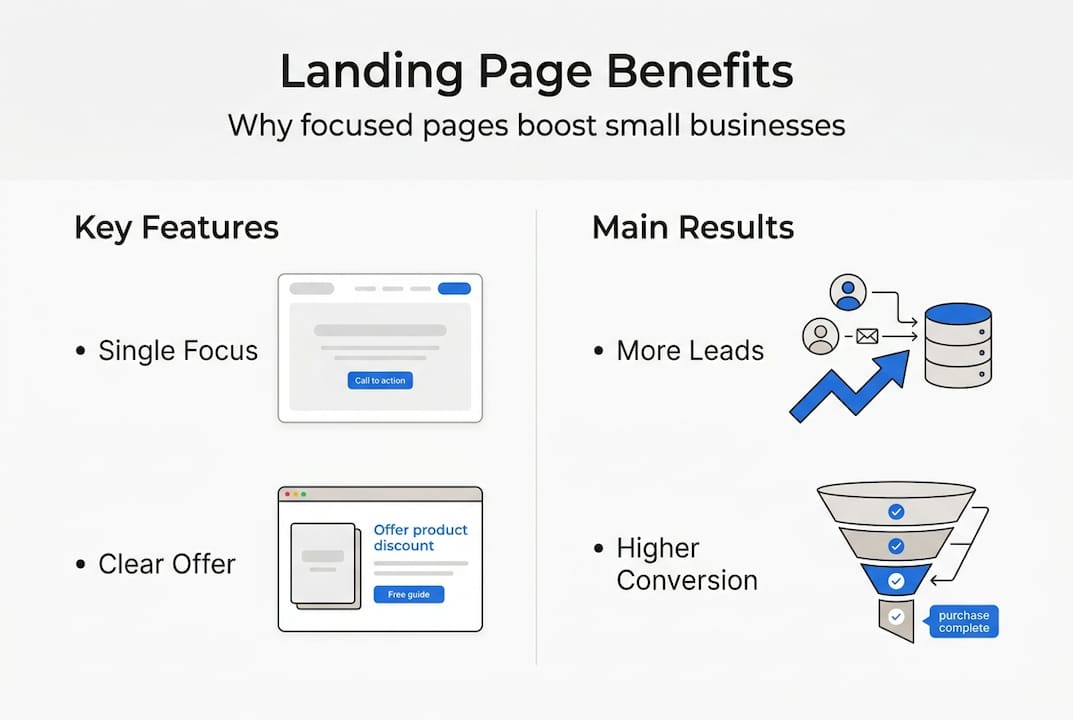
Faster setup. Building a new landing page takes far less time than redesigning your entire website. At Digital Biz Agent, we can build a landing page in as little as one week. That means you can launch a promotion fast, before the season changes or the opportunity passes.
Better targeting. Texas is a big state. A plumber in Dallas has a different customer than a landscaper in Austin or a hair salon in El Paso. Landing pages let you speak directly to a specific city, a specific offer, or a specific type of customer. General pages can't do that as well.
Affordable testing. Not sure if a new service will sell? Build a landing page for it first. Run a small ad. See if people click and fill out the form. If they do, you have proof of demand before you invest more money. If they don't, you've learned something valuable for a low cost.
Trackable results. With a landing page, you can measure exactly how many people visited, how many filled out the form, and where they came from. That data helps you make smarter decisions about where to spend your marketing dollars.
Here are the most common ways Texas small businesses use landing pages to generate leads:
- Home services companies (HVAC, roofing, plumbing) running seasonal promotions
- Restaurants and food trucks offering first-visit discounts or loyalty sign-ups
- Salons and spas collecting appointment requests for new service launches
- Real estate agents targeting buyers or sellers in specific zip codes
- Local gyms and fitness studios promoting free trial memberships
The data is clear. A focused, well-built landing page consistently outperforms a general website page when the goal is lead generation. And for Texas businesses running local ads, the difference in results can be significant. Modern website tips for Texas businesses consistently point to focused landing pages as one of the fastest ways to improve marketing performance without a large investment.
The key word is "focused." One offer. One audience. One action. That formula works whether you're a solo contractor or a growing local chain.
Our take: Why most small businesses miss the landing page opportunity
Most business owners understand, at some level, that they need a website. They spend time and money building it, getting the colors right, adding photos, writing the service descriptions. Then they launch the site, run a few ads pointing to the homepage, and wonder why the phone isn't ringing more.
Here's the uncomfortable truth. Your homepage was never designed to convert ad traffic. It was designed to introduce your brand to curious visitors. Those are two completely different jobs, and asking one page to do both is why so many marketing budgets get wasted.
We see this constantly with Texas small businesses. A roofing company in Lubbock spends $500 a month on Google ads and sends every click to their homepage. Their homepage has a menu, a video, a blog section, and a general contact form at the bottom. The ad says "Free roof inspection this week." But the page says nothing of the sort. The visitor is confused. They leave. The business owner thinks Google ads don't work.
The real problem is a missing landing page.
What's even more striking is how affordable and fast the fix actually is. One focused landing page, built specifically for that ad campaign, could change those results dramatically. We're not talking about a full website rebuild. We're talking about a single page with a strong headline, a clear offer, a short form, and a few trust signals.
The other missed opportunity we see is not creating dedicated pages for each core service or offer. If you run a cleaning business that does both residential and commercial cleaning, those are two different customers with two different problems. One landing page for each makes your message far more relevant and far more likely to convert.
At Digital Biz Agent, we guide clients through this process with a clear strategy backed by client-focused web design principles. The result is pages that are built around what your customer needs to see, not just what looks good on a screen.
Landing pages are not complicated. But they do require intentional design. Most small business owners skip them not because they don't see the value, but because no one has shown them how simple and affordable the process can be.
Want landing pages that deliver results?
If you've read this far, you now know more about landing pages than most small business owners in Texas. You understand what they are, why they work, and how to use them to bring in more leads without rebuilding your entire website.

At Digital Biz Agent, we build custom landing pages for Texas small businesses starting at just $25 per month. Our process is simple: we learn your goal, design your page for free, and launch it fast, often within one week. You can explore our full website design and SEO services or check out our simple pricing plans to find the right fit for your budget. And if you want to make sure your marketing dollars are working hard, take a look at the most common marketing mistakes to avoid so you can sidestep the pitfalls that slow most businesses down.
Frequently asked questions
What is the main goal of a landing page?
A landing page aims to convert visitors into leads or customers by focusing them on a single call to action. As research confirms, landing pages drive lead generation through a form or focused CTA rather than offering multiple options.
How is a landing page different from my website's homepage?
A landing page has one goal and minimal navigation, while your homepage provides broad information and many links for all types of visitors. A well-built landing page removes distractions so visitors focus on one next step.
Can a landing page be part of my existing website?
Yes, you can add landing pages to your current website to support specific offers, ads, or marketing campaigns without rebuilding anything else.
What should every landing page include?
Every landing page should have a clear headline, a focused offer, a call to action, and a way to contact or collect visitor info. Research shows that landing pages use forms or a strong CTA supported by relevant content to drive results.
Are landing pages expensive to create?
Landing pages are generally much less costly than full websites and can provide a fast return on investment, especially when tied to a specific ad campaign or promotion.