
TL;DR:
- Digital marketing is affordable, measurable, and highly targeted for Texas small businesses.
- Focusing on local SEO and website optimization yields the best return on investment.
- Success requires defining clear goals, tracking results, and avoiding overextending efforts.
Many Texas small business owners assume digital marketing is out of reach. Too expensive. Too technical. Too much time. That belief is costing you customers. Digital marketing is affordable and results-driven even for businesses running on tight budgets. The key is knowing where to focus. This guide walks you through the core channels, how to budget smartly, what to measure, and which mistakes to avoid. Whether you run a plumbing company in Lubbock or a boutique in Austin, these strategies are built for you.
Table of Contents
- Understanding digital marketing: What it means for Texas small businesses
- Core digital marketing channels: Proven paths for small business growth
- Budgeting and measuring ROI: Making your marketing dollars work in Texas
- Avoiding common digital marketing pitfalls: Lessons from Texas small businesses
- A Texas digital marketing perspective: What most guides don't tell you
- Ready to grow? Affordable digital marketing solutions for Texas small businesses
- Frequently asked questions
Key Takeaways
| Point | Details |
|---|---|
| Digital marketing is affordable | Small Texas businesses can be competitive online with focused strategies and modest budgets. |
| Focus on local SEO | Optimizing for local search and Google Business Profile drives the best results for attracting nearby customers. |
| Track your ROI | Measuring every marketing dollar and channel helps you avoid waste and improve results over time. |
| Avoid common mistakes | Define your target audience and stick to one or two channels to maximize your effectiveness. |
| Action leads to growth | Applying even basic digital marketing principles can help your Texas business grow in 2026 and beyond. |
Understanding digital marketing: What it means for Texas small businesses
Digital marketing is the practice of promoting your business through online channels. That includes your website, search engines, social media, email, and paid ads. It is different from traditional marketing in one important way: you can track every dollar you spend and see exactly what it produces.
Traditional marketing means billboards, radio spots, and print flyers. You spend the money and hope it works. Digital marketing gives you data. You know how many people saw your ad, clicked it, and called your business. That visibility changes everything for a small business owner watching a tight budget.
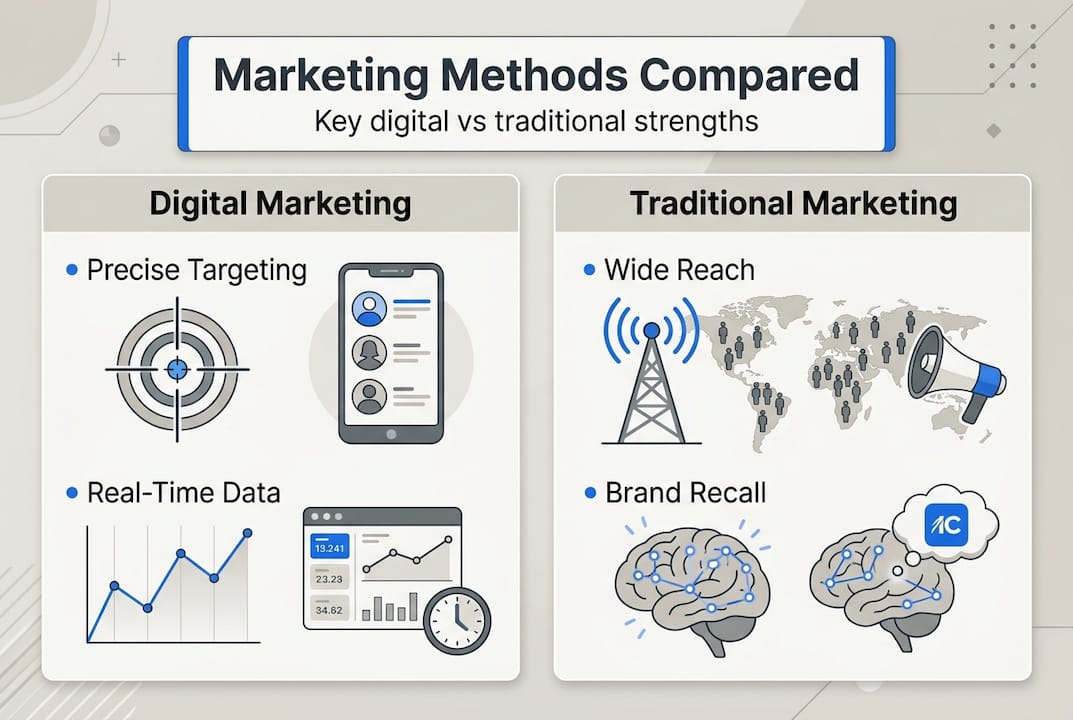
| Factor | Digital marketing | Traditional marketing |
|---|---|---|
| Targeting | Zip code, age, interest | Broad geographic area |
| Starting cost | As low as $5/day | Hundreds to thousands |
| ROI tracking | Real-time, measurable | Difficult to measure |
| Reach | Local or national | Mostly local |
| Adjustability | Change anytime | Fixed once published |
For Texas businesses, the local focus is a major advantage. You can run a Google ad that only shows to people searching within 10 miles of your shop. You can post on Facebook and target users in your specific city. That kind of precision was never possible with a newspaper ad.
Here is what digital marketing covers for a typical small business:
- Website: Your digital storefront, open 24/7
- SEO (search engine optimization): Getting found on Google without paying per click
- PPC (pay-per-click ads): Paid ads on Google or social media
- Social media: Building community and brand awareness
- Email marketing: Staying in front of existing and potential customers
- Content marketing: Blog posts, videos, and guides that build trust
"Digital marketing is trackable and targeted, unlike traditional channels, making it especially powerful for small businesses with limited budgets."
One common misunderstanding is that digital marketing is only for national brands with big teams. That is not true. In fact, local businesses have a natural edge because they serve a specific community. The goal is not to compete with Amazon. It is to be the first name a neighbor finds when they need what you offer. Avoiding marketing mistakes early on helps you build that edge faster.
Core digital marketing channels: Proven paths for small business growth
Now that the basics are clear, let's look at the specific channels you can use to grow your Texas business. Each one serves a different purpose, and the smartest approach is to use them together.
- Website: This is your foundation. Every other channel sends traffic here. A mobile-first, fast-loading site builds trust instantly. Review the website must-haves before you invest in any ads.
- Local SEO: This means optimizing your Google Business Profile, using location-specific keywords, and collecting customer reviews. For a Texas business, showing up in local map results can drive more calls than any paid ad.
- PPC ads: Google Ads puts your business at the top of search results immediately. Start with a small daily budget and test which keywords convert. Scale only what works.
- Social media: Platforms like Facebook and Instagram help you stay visible in your community. Post consistently, respond to comments, and share content that reflects your brand.
- Email marketing: One of the highest-return channels available. A simple monthly newsletter keeps your business top of mind for past customers.
- Content marketing: Blog posts and how-to guides build trust and support your SEO. Write about topics your local customers actually search for.
| Channel | Pros | Cons | Expected ROI |
|---|---|---|---|
| SEO | Long-term traffic, low cost | Takes 3-6 months | ~$22 per $1 spent |
| PPC | Fast results, targeted | Costs per click | ~200% return |
| High ROI, direct reach | Requires a list | ~$36-44 per $1 | |
| Social media | Brand awareness, community | Time-intensive | Variable |
| Content | Builds authority, supports SEO | Slow to build | Long-term compound |
Core methodologies like local SEO, PPC, social, email, and content work best when connected. For example, a PPC ad captures a lead, and that lead goes into your email list for follow-up. Check the local SEO tips that work specifically for Texas markets.
According to 2026 marketing trends, small businesses are increasing their digital budgets this year to stay competitive. You do not need to match their spend. You need to be smarter with yours.
Pro Tip: Do not try to run every channel at once. Pick two that match your goals and your capacity. Master those before adding more.
Budgeting and measuring ROI: Making your marketing dollars work in Texas
Knowing where to invest is only half the equation. A smart plan also means making the most of every dollar and measuring your results.

Most experts recommend spending 7-10% of your revenue on marketing. For a business bringing in $200,000 a year, that is $14,000 to $20,000 annually. The majority of that should go toward digital channels. SMBs spend 53-72% of their marketing budget on digital in 2026, and the ROI data backs that up.
Here are the key metrics you should track for each channel:
- CPC (cost per click): How much you pay each time someone clicks your ad
- CTR (click-through rate): The percentage of people who click after seeing your ad
- Conversions: Calls, form fills, purchases, or any action that matters to your business
- Customer lifetime value: How much a customer spends with you over time, not just on the first visit
- Bounce rate: How quickly visitors leave your website without taking action
68% of small businesses plan to increase their digital marketing budgets in 2026, signaling that local competitors are investing more. Staying still is falling behind.
The ROI numbers are real. Email marketing returns roughly $36 to $44 for every dollar spent. SEO delivers about $22 per dollar over time. PPC campaigns average around 200% return when managed well. These are not guarantees, but they show the potential when you track and adjust consistently.
Avoid the most common budget mistake: spending money without measuring results. Set up Google Analytics on your website. Check it monthly. Look at which pages get traffic and which ones lose visitors fast. Use that data to make small, regular improvements. Explore affordable marketing strategies that match your current budget and goals.
Another pitfall is ignoring local channel opportunities. Many Texas businesses skip their Google Business Profile entirely. That profile is free and often the first thing a customer sees. Fill it out completely. Add photos. Respond to every review. It costs nothing and builds credibility fast. Review what digital marketing pitfalls to avoid before you start spending.
Pro Tip: Track your results in a simple spreadsheet if analytics tools feel overwhelming. Date, channel, spend, leads, and sales. That is all you need to start seeing patterns.
Avoiding common digital marketing pitfalls: Lessons from Texas small businesses
Let's spotlight where small businesses stumble most and how you can avoid these issues right here in Texas.
90% of small businesses fail at digital marketing due to lack of focus and measurement. That is a fixable problem. Here are the most common mistakes and how to sidestep them:
- No defined target audience. If you are marketing to everyone, you are reaching no one. Know who your best customer is. Where do they live? What do they search for? What problem are they trying to solve?
- Trying to do everything at once. New business owners often launch a website, run ads, post daily on three platforms, and start a blog simultaneously. That spreads attention too thin. Focus on one or two channels first.
- Inconsistent or promotional-only content. Follow the 80/20 rule: 80% of your content should provide value, tips, answers, or local insights. Only 20% should promote your services directly. Audiences tune out constant sales pitches.
- Not measuring results. Many businesses run campaigns for months without checking if they are working. Set a monthly review date. Look at what is performing and what is not. Adjust accordingly.
"Strategy gaps and poor measurement are why most small businesses fail at digital marketing. The fix is not complicated. It is consistency and focus."
Review the mistakes to avoid that we see most often from Texas business owners. Also, make sure your website essentials are in place before you drive paid traffic. Sending clicks to a slow or confusing site wastes every dollar you spend on ads.
Pro Tip: Set a calendar reminder for the first Monday of every month. Spend 30 minutes reviewing your top three metrics. Small monthly tweaks compound into big annual gains.
A Texas digital marketing perspective: What most guides don't tell you
Here is something most marketing guides skip: Texas markets run on relationships. A customer in Lubbock or San Antonio is not just searching for a service. They are looking for someone they can trust. That changes how you should approach your marketing.
National tactics do not always translate here. Viral content strategies built for coastal audiences often fall flat in Texas communities. What works is showing up consistently in local search, collecting genuine reviews, and building partnerships with neighboring businesses. Those three things cost almost nothing and carry enormous weight.
The real mistake we see is chasing every new tool. AI, automation, and new platforms all have value. But they should support your authentic local voice, not replace it. Customers can tell the difference between a business that cares about its community and one running generic automated posts.
Start simple. A well-optimized Google Business Profile and a clean website with engagement-boosting features will outperform a complicated campaign with no clear focus. Measure what you do. Refine it. Then grow.
Ready to grow? Affordable digital marketing solutions for Texas small businesses
You now have a clear picture of what digital marketing involves, which channels to prioritize, and how to avoid the mistakes that hold most small businesses back. The next step is putting it into action.

At Digital Biz Agent, we work with Texas small business owners who want real results without the high price tag of a traditional agency. From building your website essentials to running local SEO campaigns, our team handles the details so you can focus on running your business. Explore our digital marketing services or learn more about the importance of a website for your long-term growth. Plans start at $25/month. Free demos available. Let's build something that works for your community.
Frequently asked questions
How much should a small Texas business budget for digital marketing?
Most experts recommend budgeting 7-10% of your annual revenue, with the majority of that going toward digital channels for the best measurable return.
Which digital marketing channel is best for local results?
Local SEO is the most effective starting point for Texas businesses, especially when your Google Business Profile is fully optimized and regularly updated with customer reviews.
How do I track the success of my digital marketing campaigns?
Use Google Analytics to monitor clicks, leads, and conversions, and check your local profile insights monthly to spot what is driving real customer actions.
What's the number one mistake Texas small businesses make in digital marketing?
The biggest mistake is failing to define a clear target audience and measurable goals before spending a single dollar on ads or campaigns.
Are there affordable options for Texas businesses just starting with digital marketing?
Yes. A well-designed website paired with local SEO basics gives you a strong foundation at low cost, and both can be launched and managed without a large team or budget.
Recommended
- How to improve business online presence: affordable strategies for Texas SMBs 2026
- Easy SEO tips for Texas small businesses: boost local visibility
- Top website designs that boost Texas small businesses
- Website design for Texas small businesses: 7 key steps
- Free Business Tools | Rich Harrington - Cyberpunk-Grade Utilities