
Many small business owners believe HTTPS is only for large corporations with big IT budgets. This misconception costs Texas entrepreneurs customers, search rankings, and legal protection every day. HTTPS encrypts sensitive data like credit card numbers and login credentials, preventing hackers from stealing customer information. It also signals trust to visitors and boosts your Google rankings. Best of all, implementing HTTPS in 2026 is easier and more affordable than ever, with free options available. This guide explains why HTTPS matters for your Texas small business and how to implement it correctly without breaking the bank.
Table of Contents
- How HTTPS protects your small business and customers
- The SEO and trust benefits of switching to HTTPS
- Implementing HTTPS for your small business: practical steps and common mistakes
- Why HTTPS compliance matters for Texas small businesses
- Secure your Texas small business website with expert help
- Frequently asked questions
Key takeaways
| Point | Details |
|---|---|
| Data protection | HTTPS encrypts customer information like payments and passwords, preventing theft during transmission |
| Search visibility | Google prioritizes secure sites in rankings, giving HTTPS websites a competitive edge |
| Customer trust | Browser warnings scare away visitors from non-HTTPS sites, reducing conversions and sales |
| Legal compliance | Texas breach notification laws require businesses to protect customer data or face penalties |
| Easy implementation | Free SSL certificates and simple setup make HTTPS accessible for any budget |
How HTTPS protects your small business and customers
HTTPS stands for Hypertext Transfer Protocol Secure. It uses SSL (Secure Sockets Layer) or TLS (Transport Layer Security) encryption to protect data traveling between your website and your customers' browsers. Without this encryption, anyone monitoring the network can read sensitive information like credit card numbers, social security numbers, login passwords, and personal addresses. HTTPS encrypts data transmitted between a website and a user's browser, making it unreadable to attackers even if they intercept it.
Think of HTTPS like a sealed envelope versus a postcard. HTTP sends information on a postcard where anyone handling it can read your message. HTTPS seals that information in an envelope that only the intended recipient can open. For small businesses processing payments, collecting customer information, or requiring user logins, this protection is critical.
HTTPS protects three key aspects of your website security:
- Encryption scrambles data so hackers cannot read stolen information
- Authentication verifies visitors connect to your real website, not a fake copy
- Data integrity ensures transmitted information arrives unchanged and complete
HTTPS provides authentication, ensuring users connect to the legitimate website and not a malicious imposter. This prevents man-in-the-middle attacks where criminals position themselves between your customer and your website to steal data or inject malware. Phishing scams often rely on fake websites that look identical to legitimate businesses. HTTPS certificates help browsers verify your site's authenticity.
Small businesses are prime targets for cyberattacks because criminals assume you lack enterprise-level security. A data breach can destroy your reputation overnight and trigger costly legal obligations under Texas law. Understanding why small business websites matter includes recognizing that security builds the foundation for customer relationships.
"Your website is often the first impression customers have of your business. HTTPS tells them you take their privacy seriously and invest in their protection."
The Texas Identity Theft and Data Security Breach Notification Act requires businesses to notify customers within 60 days of discovering a breach involving personal information. Without HTTPS, you increase breach risk and potential liability. Even if you do not process payments directly, customer emails, phone numbers, and browsing behavior deserve protection.
The SEO and trust benefits of switching to HTTPS
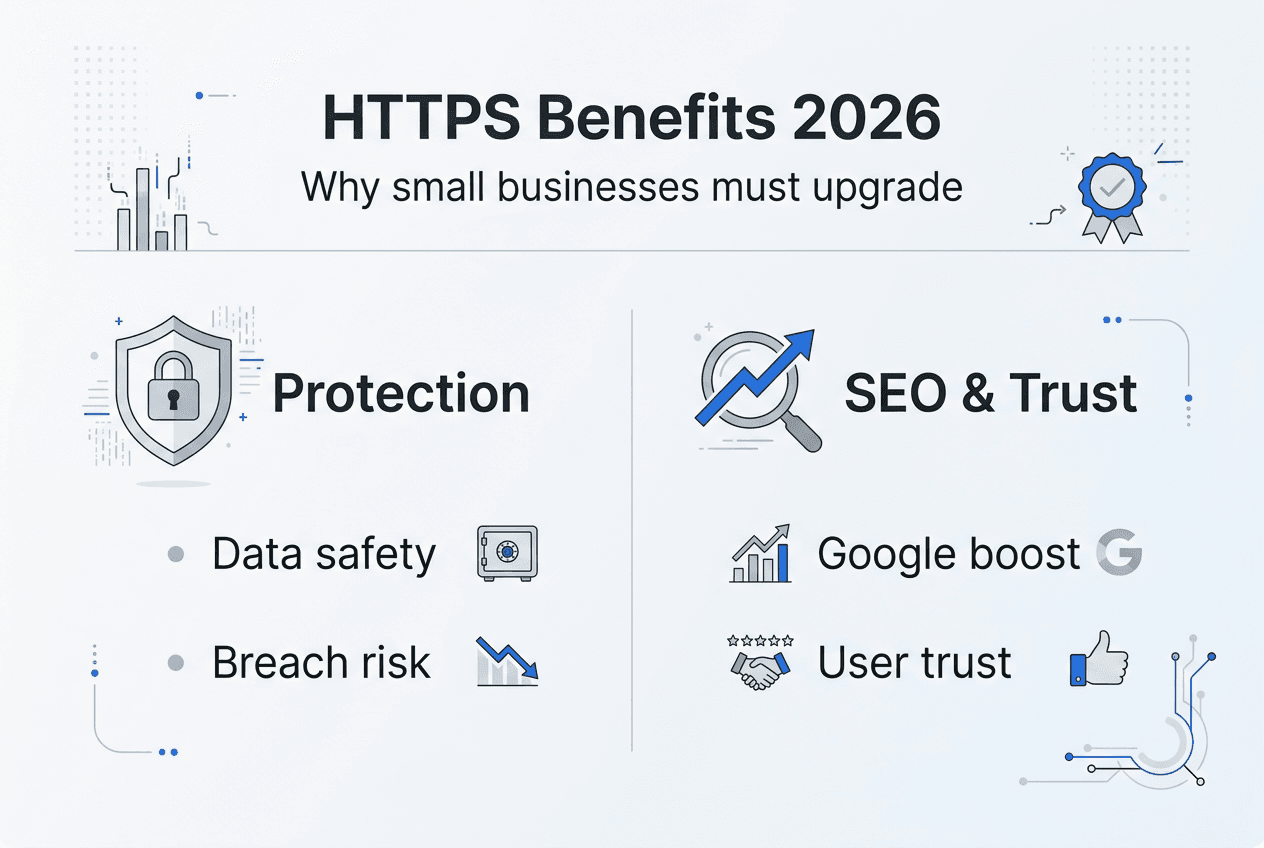
Google considers SSL a ranking factor, giving preference to SSL-secured websites in search results. This means two identical websites competing for the same keywords will see the HTTPS version rank higher. For Texas small businesses competing in local search results, this advantage can mean the difference between appearing on page one or page three.
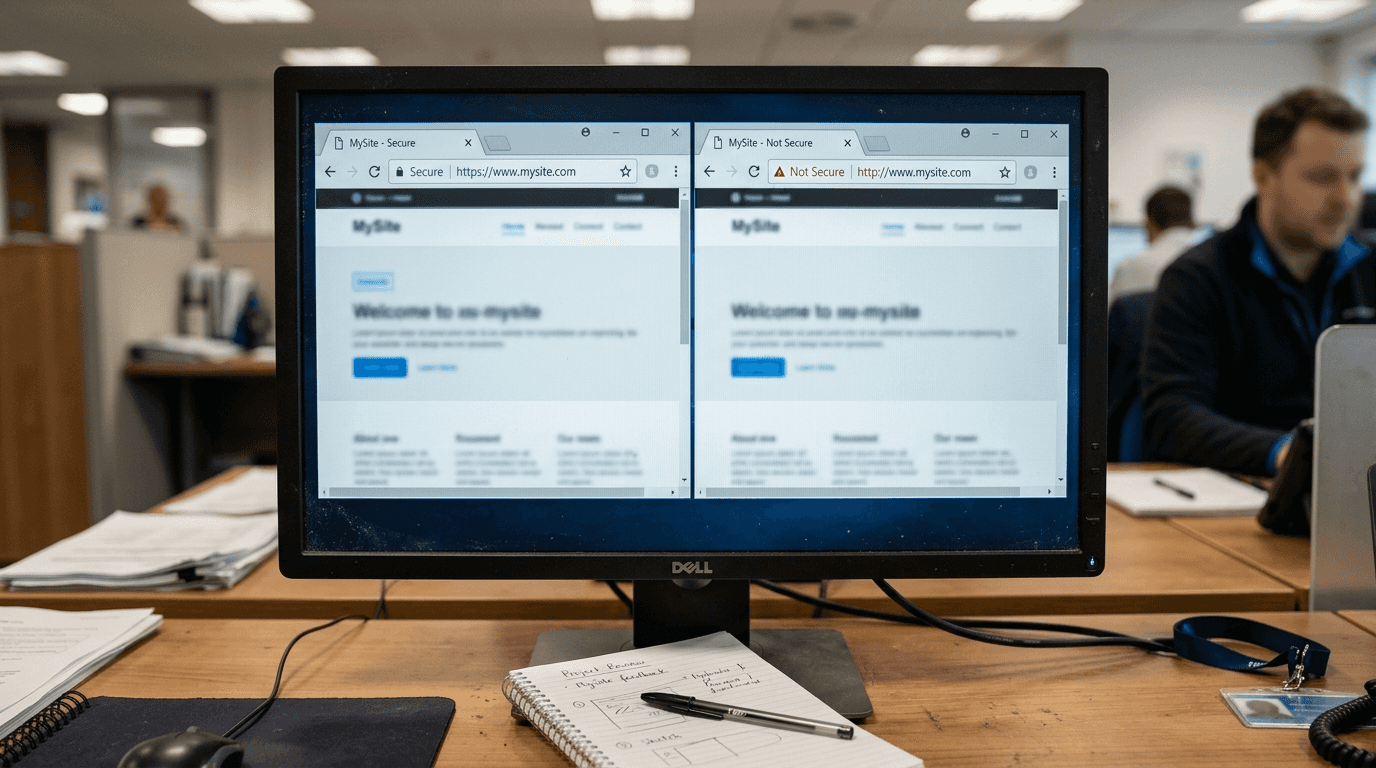
Beyond rankings, websites without HTTPS are marked as "Not Secure" by browsers, leading to decreased user trust and higher bounce rates. When potential customers see that warning in their browser bar, many immediately leave without exploring your services. This security warning appears before they even read your content, creating an instant credibility problem.
HTTPS signals professionalism and modern standards. Over 88% of websites now use HTTPS by default, making non-secure sites stand out negatively. Customers increasingly expect encryption as standard practice, not an optional upgrade. Running an HTTP-only site in 2026 is like operating a store with broken locks on the doors.
The trust factor extends beyond conscious decisions. Subconsciously, visitors feel more comfortable sharing information on secure sites. This comfort translates to:
- Higher form completion rates for contact forms and quote requests
- Increased newsletter signups and email collection
- Better conversion rates on product pages and service inquiries
- Longer average session duration as visitors explore more pages
Search engines track user behavior signals like bounce rate and time on site. When visitors immediately leave your HTTP site due to security warnings, Google interprets this as a sign of poor quality content. This creates a negative feedback loop hurting your rankings further. Learning why updating your website boosts local SEO includes understanding how security updates improve search performance.
Pro Tip: Set up monitoring to alert you if your HTTPS certificate expires or configuration breaks. A sudden switch from HTTPS to HTTP can tank your rankings overnight and trigger security warnings for returning customers. Most hosting providers offer automatic renewal, but verification ensures nothing falls through the cracks.
HTTPS also enables modern web features that HTTP sites cannot access. Progressive Web Apps, certain APIs, and advanced browser capabilities require secure connections. As web technology evolves, HTTP-only sites will face increasing functional limitations. Implementing essential website features requires HTTPS as the foundation.
Implementing HTTPS for your small business: practical steps and common mistakes
Implementing HTTPS is no longer complex or expensive, with free SSL/TLS certificates readily available from providers like Let's Encrypt. Here is how to get your small business website secured:
- Choose an SSL certificate provider that fits your needs and budget
- Generate a certificate signing request (CSR) through your hosting control panel
- Validate your domain ownership via email, DNS record, or file upload
- Install the issued certificate on your web server or through your host
- Configure your site to redirect all HTTP traffic to HTTPS automatically
- Update internal links and resources to use HTTPS URLs
- Test thoroughly across different browsers and devices
- Submit your HTTPS site to Google Search Console for reindexing
Most modern hosting providers simplify this process dramatically. Many offer one-click SSL installation that handles steps 2 through 6 automatically. If your host does not provide easy SSL setup, exploring free SSL providers can help you find better options.
Let's Encrypt provides free certificates trusted by all major browsers. These certificates auto-renew every 90 days, eliminating the risk of expiration if configured correctly. Paid certificates from providers like DigiCert or Sectigo offer extended validation and warranty protection, but small businesses rarely need these premium features for basic security.
| Certificate Type | Validation Level | Price Range | Best For |
|---|---|---|---|
| Domain Validated (DV) | Basic domain ownership | Free to $50/year | Small business websites, blogs |
| Organization Validated (OV) | Business verification | $50 to $200/year | E-commerce, professional services |
| Extended Validation (EV) | Rigorous business checks | $200 to $500/year | Large enterprises, financial institutions |
| Wildcard | Covers all subdomains | $100 to $300/year | Sites with multiple subdomains |
For most Texas small businesses, a free Domain Validated certificate provides identical encryption and browser trust as expensive options. The validation level affects the visual indicators in the browser bar, not the actual security strength.
Implementing SSL/TLS certificates is now an absolute standard for every website, but common mistakes can undermine your security:
- Mixed content errors occur when HTTPS pages load images, scripts, or stylesheets over HTTP, triggering browser warnings
- Expired certificates cause security errors that block visitors entirely, often due to failed auto-renewal
- Weak cipher suites allow outdated encryption methods that sophisticated attackers can break
- Incomplete redirects leave some pages accessible via HTTP, creating security gaps
- Missing HSTS headers fail to force browsers to always use HTTPS for your domain
Pro Tip: After implementing HTTPS, use online tools like SSL Labs' Server Test to verify your configuration scores an A rating. This free tool identifies weak ciphers, missing headers, and other security issues you can fix before they cause problems.
Content Delivery Networks (CDNs) like Cloudflare provide free HTTPS certificates while improving your site speed and security. CDNs cache your content across global servers, reducing load times for visitors and protecting against DDoS attacks. For small businesses, free CDN plans offer enterprise-level security without enterprise costs. Following the Google HTTPS implementation guide ensures you meet search engine best practices during migration.
Why HTTPS compliance matters for Texas small businesses
The Texas Identity Theft and Data Security Breach Notification Act creates legal obligations for businesses handling personal information. The Texas Data Breach Notification Act mandates specific actions for businesses in the event of a data breach, including notifying affected individuals within 60 days. This law applies regardless of business size, meaning your small business faces the same notification requirements as major corporations.
The Texas Data Breach Notification Act applies to any individual or business that owns or licenses computerized data including sensitive personal information and conducts business in Texas. Sensitive personal information includes social security numbers, driver's license numbers, financial account numbers, and other data that could enable identity theft.
HTTPS significantly reduces your breach risk by encrypting data in transit. While it does not protect against all attack vectors like server hacks or employee errors, it eliminates the easiest attack method: network interception. For small businesses without dedicated IT security teams, HTTPS provides critical baseline protection.
Consequences of data breaches extend far beyond legal penalties:
- Reputation damage that drives customers to competitors
- Notification costs for contacting affected individuals
- Legal fees for compliance and potential lawsuits
- Credit monitoring services you may need to provide victims
- Lost revenue from decreased customer trust and sales
Texas law requires businesses to notify affected individuals "as quickly as possible" after discovering a breach. You must also notify major credit reporting agencies if the breach affects more than 10,000 individuals. Failure to comply can result in civil penalties up to $100 per individual affected, with maximum penalties reaching millions for large breaches.
HTTPS forms one layer of a comprehensive security strategy. You also need secure hosting, regular software updates, strong password policies, and employee training. However, HTTPS is the most visible security measure to customers and the easiest to implement correctly. When building a small business website in Texas, security should be a primary consideration from day one, not an afterthought.
Even businesses that do not directly collect payment information need HTTPS. Customer emails, phone numbers, and browsing behavior all constitute personal information worth protecting. If your website includes contact forms, newsletter signups, or user accounts, you handle data that requires encryption. The Texas breach notification law does not exempt small businesses or specific industries, making HTTPS protection universal.
Secure your Texas small business website with expert help
Protecting your customers and boosting your search rankings does not require technical expertise when you work with professionals who understand small business needs. Digital Biz Agent specializes in creating secure, modern websites for Texas entrepreneurs, with HTTPS implementation included in every project. Our website design and SEO services ensure your site meets 2026 security standards while ranking well in local search results.
We handle the technical details so you can focus on running your business. From free SSL certificates to ongoing security monitoring, our affordable plans start at just $25 per month. Every website we build includes the essential features small businesses need, including mobile responsiveness, fast loading speeds, and complete HTTPS protection. Check our pricing plans to find the perfect fit for your budget and goals.
Frequently asked questions
What is HTTPS and why should my small business use it?
HTTPS encrypts data transmitted between your website and visitors' browsers, protecting sensitive information from interception. Small businesses need HTTPS to secure customer data, improve Google rankings, build trust with visitors, and comply with Texas data protection laws. Modern browsers warn users when visiting non-HTTPS sites, which damages credibility and increases bounce rates.
How much does it cost to get HTTPS for my website?
Many SSL certificate providers offer free options, with Let's Encrypt being the most popular choice for small businesses. Free certificates provide the same encryption strength as paid options and work with all major browsers. Paid certificates range from $50 to $500 annually and offer additional features like extended validation or warranty protection, but most small businesses do not require these premium features for adequate security.
Will switching to HTTPS improve my Google search ranking?
Yes, Google uses HTTPS as a confirmed ranking factor in its search algorithm. Secure sites receive preference over identical non-secure sites in search results. Additionally, HTTPS improves user experience by eliminating security warnings, which reduces bounce rates and increases time on site. These positive user behavior signals further boost your rankings over time.
What happens if I don't use HTTPS on my small business website?
Without HTTPS, attackers can intercept and read sensitive customer data transmitted to your site. Modern browsers display prominent "Not Secure" warnings that deter visitors and damage trust. You risk lower Google rankings since search engines prioritize secure sites. Most importantly, you increase your liability under Texas breach notification laws, which require businesses to protect personal information and report breaches within 60 days.