TL;DR:
- Strong branding builds customer trust and recognition over time, beyond just advertising.
- Consistency across all platforms and bilingual support are crucial for Texas small businesses.
- Effective branding includes visual identity, messaging, customer experience, and local cultural cues.
Many Texas small business owners pour money into ads, social media posts, and flyers, but still struggle to attract steady customers online. The problem is not the budget. It is the brand. Without a clear, consistent identity, your marketing efforts pull in different directions and confuse potential buyers before they ever contact you. Branding is much more than a logo or a color scheme. It is the full picture a customer sees and feels when they encounter your business. This guide walks you through every step, from laying the groundwork to measuring real results, so your Texas business can stand out and grow online.
Table of Contents
- What is small business branding — and why does it really matter?
- What you need before you start: Branding toolkit for Texas small businesses
- Step-by-step branding process: How to build your unique identity
- Common branding mistakes to avoid and how to measure your success
- What most branding guides miss about Texas small businesses
- Ready to build your brand? Affordable help for Texas small businesses
- Frequently asked questions
Key Takeaways
| Point | Details |
|---|---|
| Branding is more than a logo | A strong brand includes messaging, consistent visuals, and customer experience, not just your logo. |
| Preparation is key | Gather all brand assets and ensure bilingual, local relevance before launching your website. |
| Strategic steps drive results | A step-by-step, strategic process compounds trust and visibility more than quick-fix tactics. |
| Avoid common mistakes | Track metrics and steer clear of logo-only branding and inconsistent messaging, especially for Texas and bilingual markets. |
What is small business branding — and why does it really matter?
Branding is not just what your business looks like. It is what your business means to people. Think about it this way: two taco stands on the same street can sell identical food. The one with a clear name, a welcoming sign in both English and Spanish, a consistent Instagram page, and a friendly reply policy will win more repeat customers. Every single time.
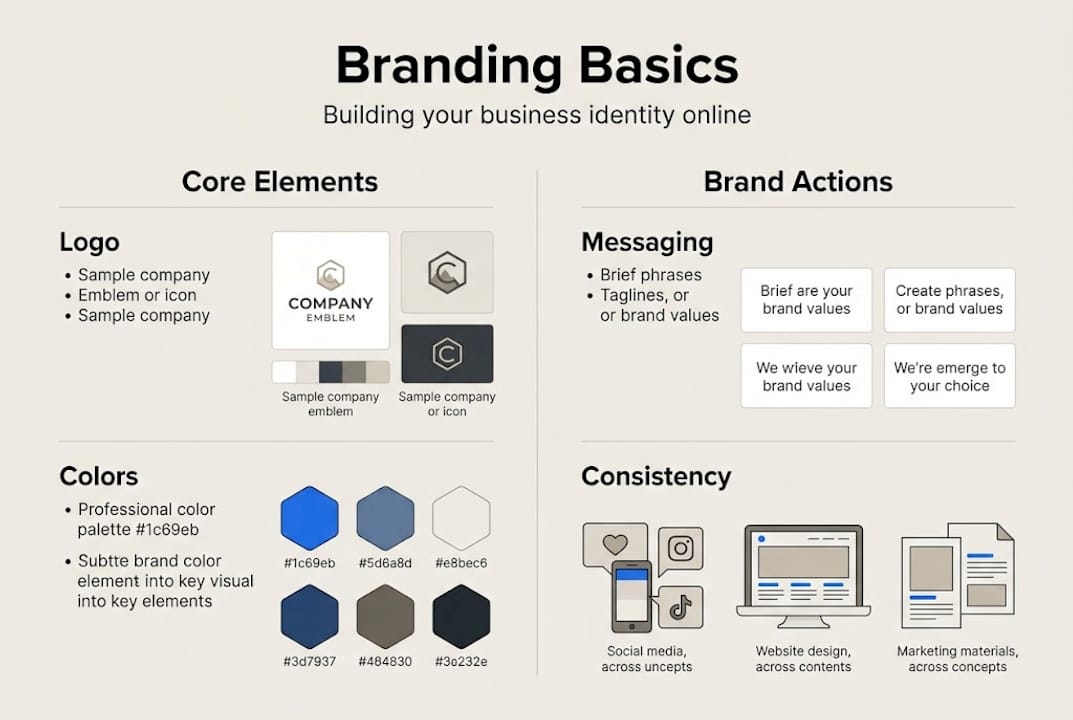
A logo is only 25% of the branding equation. The rest is made up of your messaging, your tone of voice, your customer experience, and how consistently you show up across every platform, from Google to Facebook to your own website.
Branding includes these core elements:
- Your business name and tagline
- Your logo and color palette
- Your fonts and visual style
- Your brand voice (how you write and speak to customers)
- Your customer service standards
- Your online presence and how it looks across all channels
- Your bilingual messaging if you serve Spanish-speaking customers
For Texas businesses, this last point is especially important. Texas has one of the largest Spanish-speaking populations in the United States. If your brand only communicates in English, you are leaving money on the table. Bilingual branding is not just a nice touch. It is a real competitive advantage.
Why branding compounds over time
The biggest reason small business owners underestimate branding is that results are not instant. Unlike a paid ad that gets clicks the same day, branding builds trust slowly and then all at once. Every time a customer sees your logo on a Facebook post, reads a consistent message on your website, or hears your business name from a friend, recognition grows. That recognition becomes trust. Trust becomes sales.
Here is a simple comparison to show the difference between a weak and a strong brand presence:
| Factor | Weak brand presence | Strong brand presence |
|---|---|---|
| Logo | Only on business cards | On website, social, signage, and invoices |
| Messaging | Changes depending on the platform | Consistent tone and language everywhere |
| Bilingual support | English only | English and Spanish on all channels |
| Customer reviews | Few and unmonitored | Actively collected and responded to |
| Local SEO | Not set up | Google Business profile complete and active |
| Website | Outdated or missing | Mobile-responsive and up to date |
Strong branding for Texas SMBs creates recognition that works around the clock, even when you are not actively marketing.
Now that you understand why clear branding can make or break your online presence, let's dig into what you'll need to get started.
What you need before you start: Branding toolkit for Texas small businesses
Before you design anything or write a single word of copy, you need to gather your assets and make a plan. Jumping into design without a strategy is one of the most common and costly mistakes. Digital branding focus is growing, with 22 out of 63 major business studies highlighting its importance in recent years. That growth means more competition online, which means you need to start with the right foundation.
Here is your pre-launch branding checklist:
- Clear business name and legal DBA (Doing Business As) if applicable
- One-paragraph business description in English and Spanish
- Professional logo file (PNG with transparent background is ideal)
- Two to three brand colors with hex codes
- One to two fonts for headings and body text
- A short, memorable tagline
- Your target customer profile (who are they, what do they need, where do they live)
- A list of the platforms where your customers spend time
- Your Google Business Profile login or setup plan
- A domain name registered for your business
Recommended tools for Texas small businesses
You do not need an expensive agency to pull these assets together. Several affordable tools can help you move fast without sacrificing quality.
| Tool | Purpose | Cost |
|---|---|---|
| Canva | Logo design, social graphics | Free or $13/month |
| Google Business Profile | Local SEO, maps listing | Free |
| Namecheap or GoDaddy | Domain registration | $10 to $15 per year |
| Google Workspace | Professional email | $6/month |
| Grammarly | Writing consistency | Free or $12/month |
| DeepL or Google Translate | Bilingual content drafts | Free |
Pro Tip: Do not rely only on free translation tools for your Spanish-language content. Have a bilingual speaker review your messaging before publishing. A small error in Spanish can feel dismissive to native speakers and hurt your brand.
Once you have these basics in place, look at the website essentials for small business to make sure your site covers every important base. And if budget is a concern, check out these affordable online presence strategies built specifically for Texas small business owners.
Once you've gathered these key tools and resources, you're ready to build your brand step by step.
Step-by-step branding process: How to build your unique identity
Most small businesses approach branding the way they approach putting out a fire. They react. They design a quick logo, throw up a website, and move on. But a strategic approach to branding yields far better long-term results than a purely tactical one. Here is how to build your brand intentionally.
Step 1: Define your brand story and core values. Write down why you started your business, who you serve, and what makes you different. Keep it simple. A two-sentence answer is fine. This becomes the foundation for all your messaging.
Step 2: Identify your target customer. Give them a name if it helps. Are they a Spanish-speaking homeowner in El Paso? A bilingual restaurant owner in San Antonio? A construction contractor in Lubbock? Knowing exactly who you are talking to shapes every visual and word choice you make.
Step 3: Choose your visual identity. Pick two to three colors that reflect your brand personality. Blue communicates trust. Green suggests growth. Orange feels approachable. Select fonts that are easy to read on a phone screen, since most of your customers will find you on mobile. Make sure your logo reads clearly in both color and black and white.
Step 4: Write your brand voice guidelines. Decide how you sound. Are you warm and conversational? Direct and professional? Playful and local? Write three to five sample sentences in your brand voice and test them on someone who represents your target customer. For bilingual businesses, do this in both languages.
Step 5: Set up your core digital assets. This includes your website, Google Business Profile, Facebook or Instagram page, and any relevant local directories like Yelp or Thumbtack. Each one should use the same logo, the same colors, the same bio, and the same contact information.
"Your brand is what other people say about you when you're not in the room." Whether those people are speaking English or Spanish, what they say depends entirely on the experience you designed for them.
Step 6: Launch your website fast. You do not need to wait for a perfect website. A clean, mobile-responsive site with five pages and clear contact info beats a half-finished site left in development for months. Services that specialize in branding with website design can launch a professional site in as little as one week.
Step 7: Stay consistent for at least 90 days. Post regularly on social media using your brand colors and voice. Respond to reviews in both languages if needed. Update your Google Business Profile with photos and hours. The first 90 days of consistent presence build the foundation for long-term recognition. Learn more about website importance for branding and why your site is the anchor of everything else you do online.
With your brand built, it's crucial to avoid the most common mistakes and ensure that your efforts deliver results.
Common branding mistakes to avoid and how to measure your success
Even with the best plan, it is easy to fall into traps that slow your brand growth. Short-term branding tactics do not produce the compounding effect of a long-term brand strategy. Here are the mistakes that cost Texas small businesses the most, and how to fix them.
The top three branding mistakes:
- Focusing only on the logo. Spending $500 on a beautiful logo and nothing else is like buying a great front door for a house with no walls. The logo matters, but it only works when everything around it is consistent.
- Inconsistent online presence. Your Facebook page says you close at 6 PM. Your Google listing says 7 PM. Your website says call for hours. This kind of inconsistency kills trust immediately. Customers move on to the next option.
- Ignoring bilingual and local needs. In Texas, many businesses serve customers who prefer Spanish. Skipping bilingual content means skipping a large share of your potential market. Local imagery matters too. A stock photo from a generic office building does not connect with a customer in Lubbock or Laredo.
Avoid these common small business marketing mistakes and you will already be ahead of most local competitors.
How to measure if your brand is working
You do not need a marketing degree to track brand performance. Focus on these basic signals:
| Metric | What it tells you | How to check it |
|---|---|---|
| Website bounce rate | Are visitors staying or leaving quickly? | Google Analytics |
| Google reviews and rating | How do customers feel about your business? | Google Business Profile |
| Social media engagement | Are people liking, sharing, commenting? | Facebook or Instagram Insights |
| Direct search traffic | Are people searching your business name? | Google Search Console |
| Customer mentions in Spanish | Are Spanish-speaking customers engaging? | Google reviews, social comments |
Pro Tip: Set a reminder every 90 days to review your Google Business Profile, update photos, and check that all contact information is still accurate. Small updates send signals to Google that your business is active and trustworthy.
The importance of online reviews cannot be overstated. Actively asking happy customers to leave a review in their preferred language gives you social proof in both English and Spanish.
When to refresh your brand: Plan to revisit your visual assets and messaging every one to two years. If your logo looks dated, your website is not mobile-friendly, or your messaging no longer reflects what you do, it is time for an update. Branding is not a one-time project. It is an ongoing practice.
Now that we've covered mistakes and measurement, let's take a closer look at what experts often miss when talking about small business branding.
What most branding guides miss about Texas small businesses
Most branding guides are written for a generic small business somewhere in the United States. They cover logos, websites, and social media. They do not talk about what it means to build a brand in a state as large and culturally layered as Texas.
We work directly with Texas small business owners every day. One thing we see repeatedly is that business owners treat their Spanish-speaking customers as a secondary audience, something to address eventually, rather than a core part of their brand from day one. That is a strategic mistake. Trust is earned through details: a bilingual sign on your door, a Spanish-language option on your website, a Google review response written in the same language as the reviewer. These are not extras. They are brand signals.
Another thing most guides skip is the role of local imagery and cultural cues. A contractor in West Texas does not connect with the same visuals as a restaurant owner in Houston. Your photos, your color choices, and even the words you use should reflect your specific community. Generic looks generic. Local looks real.
We also see too many businesses launch a website in a day and then never update it. A quick launch is great. A web design tailored for Texas clients should be built with ongoing management in mind, not just a one-time setup. Your brand grows when your digital presence grows with it.
Ready to build your brand? Affordable help for Texas small businesses
Building a professional brand does not have to cost a fortune or take months. If you are ready to get your business in front of more customers online, Digital Biz Agent is set up to help you move fast.
We offer bilingual website and brand packages starting at $50 per month, with full launches in as little as one week. Our team handles design, setup, SEO, and ongoing support in both English and Spanish. You focus on running your business. We make sure your online presence looks and works the way it should. Check out our full list of website and SEO services or review our affordable website pricing to find the right plan for your budget. When you are ready, launch your business website with the features that actually drive results.
Frequently asked questions
How much does small business branding cost in Texas?
Branding costs range from free or low-cost do-it-yourself tools to a few thousand dollars for full agency services, but bundled website and brand packages from providers like Digital Biz Agent start at $50 per month and include bilingual support.
Is branding just about a logo for my small business?
No. A logo is only a small part of your brand. A logo represents just 25% of the branding equation, with the rest made up of your messaging, customer experience, and consistent online identity across all platforms.
How can I brand my business quickly if I need a website right away?
Prepare your logo, a short business description in English and Spanish, and your contact information first, then use a streamlined service that can build and launch a complete, mobile-responsive site within days.
Why is bilingual branding important for Texas small businesses?
Texas has one of the largest Spanish-speaking populations in the country, and bilingual branding helps you reach more customers, build trust across cultural groups, and stand out in competitive local markets.